
A few years ago, while on vacation, I drove past a strip mall and noticed two stores that made me do a double take. One was $9.99 for all souvenirs. The other was $9.98 for all souvenirs. Technically, one was different from the other—by a penny. But was it really differentiated?
That image has stuck with me because organizations fall into the same trap constantly. They make incremental improvements. Add new capabilities. Adopt the latest technology. Benchmark competitors. Reorganize. Launch transformation initiatives. They’re changing. They’re often getting better. But they’re not necessarily becoming more distinctive.
Over time, an organization can make a series of perfectly reasonable decisions while gradually becoming more like everyone else. That’s the difference between differentiating by design and drifting by default—and for leadership teams setting strategy, it’s one of the highest-stakes questions on the table.
Can an organization have a strategy and still be drifting?
Yes. A strategic plan can be thorough and still fail to answer the one question that matters most: how will the organization win?
I’ve seen this play out many times. One example stands out: an EV charging station manufacturer whose parent company had concerns about customer dissatisfaction, rising employee turnover, and a lack of business direction. When I first sat down with the CEO, he was enthusiastic—his leadership team had just completed a strategy retreat and produced a 72-page strategic plan. There was clearly no shortage of planning.
But as we worked through the strategy together, a much more basic question remained difficult to answer: how are you going to win?
That distinction matters for anyone setting direction at the top of an organization. You can have financial objectives, functional priorities, growth initiatives, and an inspiring vision without making sufficiently clear choices about what will actually make the business different. When those choices stay vague, the ambiguity cascades into every other decision: which capabilities deserve disproportionate investment, what work matters most, where resources should shift, what the organization should stop doing, and how the organization itself should operate differently.
Why aren’t improvement and differentiation the same thing?
Leaders today have almost unlimited access to information about what great companies are doing: benchmark competitors, adopt best practices, modernize technology, simplify the structure, improve customer experience, increase speed, build agility, use AI.
None of those ideas is inherently wrong. But competitors are reading many of the same articles, attending many of the same conferences, studying many of the same companies, and adopting many of the same technologies. When everyone pursues the same definition of “better,” organizations can become increasingly sophisticated while simultaneously becoming harder to distinguish from one another.
The strategic question isn’t simply “how do we get better?” It’s “what should we become exceptionally good at because of the specific way we intend to create value?” Those are very different questions, and conflating them is one of the most common ways organizations drift.
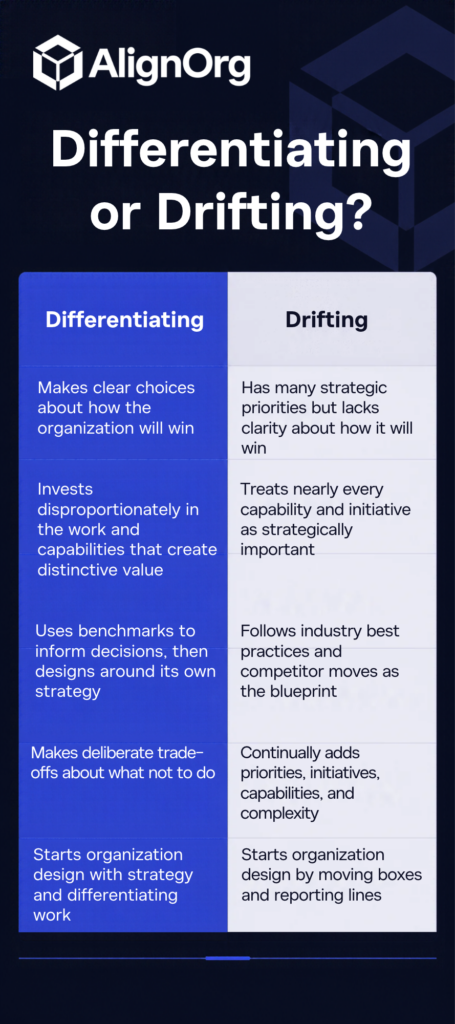
Are you differentiating or drifting?
Drift can be hard to spot from inside an organization because many of its symptoms look like progress. One way to check your own direction is to look honestly at the choices your leadership team is making:
| Differentiating | Drifting |
|---|---|
| Makes clear choices about how the organization will win | Has many strategic priorities but lacks clarity about how it will win |
| Invests disproportionately in the work and capabilities that create distinctive value | Treats nearly every capability and initiative as strategically important |
| Uses benchmarks to inform decisions, then designs around its own strategy. | Follows industry best practices and competitor moves as the blueprint. |
| Makes deliberate tradeoffs about what not to do. | Continually adds priorities, initiatives, capabilities and complexity. |
| Starts organization design with strategy and differentiating work. | Starts organization design by moving boxes and reporting lines. |
Few organizations sit entirely in one column. The more useful question for a leadership team is which direction you’re moving.
How does AI make the differentiation question more urgent?
AI is a useful test case because nearly every leadership team I speak with is wrestling with similar questions: where should we deploy it, which work should change, what can we automate, and what new capabilities will we need?
Those are necessary operational questions. But a more strategic conversation starts earlier: where could AI make us distinctly better at something fundamental to how we intend to win?
For one organization, that might mean dramatically increasing responsiveness. For another, AI could enable a level of personalization that wasn’t previously economical. A third might use AI to accelerate a capability already central to its customer promise. Choose the use case that strengthens your specific basis for winning, not the use case that’s simply trending. Otherwise, AI becomes one more initiative layered onto an already crowded agenda rather than a lever for competitive advantage.
Should organization design start with strategy or structure?
It should start with the work, not the boxes.
When an organization needs to change, leaders often move quickly to questions of structure: who reports to whom, should this function move, should we centralize or decentralize, how many layers do we need. Those may eventually be exactly the right questions. They’re just rarely the best place to start.
Before changing the structure, leaders need to understand what work needs to be different for the strategy to succeed: What work creates distinctive value? Which capabilities enable it? Which activities are essential but don’t need to differentiate the organization? Where are resources invested without materially strengthening how the organization wins?
That leads to a different sequence: strategy determines what work differentiates, which informs deliberate trade-offs about that work, which in turn shapes how the organization is designed to deliver it. Structure becomes an outcome of strategic choices, not the starting point.
Why does differentiation require saying no?
Organizations are generally much better at adding than subtracting. A new priority enters the plan. A new capability gets funded. A new market gets pursued. A new initiative launches. Relatively little comes out.
Eventually, almost everything becomes important—and when everything is strategically important, leaders have very little basis for deciding where to put disproportionate attention, resources, and talent.
Differentiation requires choices. Some capabilities deserve exceptional investment; others simply need to work well. Some customer needs should fundamentally shape the organization; others shouldn’t. Some opportunities reinforce your strategic position, while others generate revenue while quietly adding complexity and diluting what makes you distinctive. Choosing not to pursue a good idea can be harder than rejecting a bad one. But no organization differentiates by accumulating an unlimited number of good ideas.
A question for your next leadership meeting
Go back to the $9.98 and $9.99 stores. A penny created a difference. But did it create a meaningful reason to choose one over the other?
Now look at the decisions your organization has made over the past year:
- Where have you invested disproportionately?
- What capabilities have you deliberately strengthened?
- What new work have you added?
- What have you intentionally stopped doing?
- Where have you followed a best practice simply because everyone else was doing it?
- How has the organization itself changed to make your strategy easier to execute?
Step back and look at those decisions together. Do they make it easier to understand how your organization intends to win? Or are they making you a slightly different version of everyone else?
Differentiation isn’t created by one bold choice. It emerges from a series of deliberate, reinforcing choices about how an organization creates value and how it is designed to deliver it. Drift happens the same way.
Designing differentiation into the organization
For years, Ken Thompson and I have worked with leadership teams trying to translate ambitious strategies into organizations capable of delivering them. Along the way, we kept confronting a larger question: what does it really take to design an organization that can differentiate—and keep differentiating as conditions change?
That question became the foundation for our new book, Differentiation by Design: A Leader’s Guide to Building an Organization That Stands Apart, publishing December 1st. In the months ahead, AlignOrg will share more of the ideas, examples, and practical tools behind it.
For now, I’ll leave you with one question for your own leadership team: are you differentiating by design, or drifting by default?