
AI might be changing how work gets done, but it’s not changing HR leaders’ central responsibilities.
HR leaders have long been charged with four key roles:
- Enabling strategy
- Aligning structure to that strategy
- Leveraging culture to reinforce those commitments
- Developing leaders who can help the organization navigate change
What has changed is the context in which we carry out these responsibilities. That shift brings new opportunities, new challenges, and a familiar question for HR: Are we helping leaders understand what good looks like?
How AI is Reshaping HR
Consider the annual strategic review, where HR leads a discussion and assessment of the capabilities needed to deliver on the organization’s strategy. Increasingly, those conversations include questions about how AI fits into the picture.
- What opportunities exist for agentic AI to deliver productivity gains in general and administrative functions?
- In what ways can AI automate high-frequency, low-complexity tasks so we can redeploy those hours and resources toward higher-impact, more complex work?
- What capabilities will we need to support those changes?
- How might AI change how we create value for customers and differentiate ourselves from competitors?
- How should we rethink our operating model, organizational structure and decision making to capitalize on AI’s potential?
We are also in an era of experimentation, where individuals, teams and entire functions are finding ways to use AI to work more efficiently. HR needs to help ensure leaders understand the organization’s expectations for how AI is used so they can guide their teams effectively.
AI Changes Output, Not Accountability
AI is becoming commonplace for knowledge workers. I heard a colleague recently say, “I can’t even remember how I did my job before Copilot.” I suspect many people feel the same way.
What’s interesting is that while people are using AI tools to work more efficiently, analyze more quickly and contribute differently, some of those contributions are creating familiar organizational challenges that existed long before AI entered the picture.
While AI provides resources that can enhance personal productivity, it is equally capable of enabling “workslop”—low-quality output that requires critical evaluation but is often simply passed along from one individual or department to the next.
The underlying leadership challenge is familiar. Managers have always needed to establish performance expectations, evaluate the quality of work, provide feedback and hold people accountable. AI changes how work is produced, but it doesn’t relieve leaders of those responsibilities. Leaders need to understand how their teams are using AI, establish expectations around good and poor use and hold people accountable when they produce below-standard work.
The HR Leader’s Role
HR has long held the mantle for ensuring leaders are equipped to create high-performing teams with diverse talents who can deliver on their collective objectives. While the ways work gets done are changing, leaders must still be able to see, say and show what good looks like and, equally important, what does not meet expectations.
The same holds true at the executive level. If you are challenging your organization to use AI to gain efficiencies, lower costs and find new ways of doing things, you need to:
- Communicate what good looks like
- Define how that standard relates to individual and team performance
- Recognize and celebrate those who rise to the occasion
Navigating Disruption, Again
HR leaders will continue to be looked to for help as leaders, teams and organizations navigate the changes that come with AI.
We don’t have to look very far back for an example of HR leaders confronting an unfamiliar set of challenges. The global pandemic, followed by significant changes in where and how people worked, required HR leaders to draw on their existing experience and expertise to help organizations navigate circumstances few had anticipated. They had to help leaders understand new challenges, reconsider established practices and determine how to effectively lead and support their teams. There wasn’t an established playbook for much of what organizations were confronting, but the underlying responsibilities of HR and organizational leadership remained the same.
AI is a very different kind of disruption, but I think there is a parallel worth considering. HR leaders again need to apply their experience to a changing set of circumstances. The fundamental responsibilities of effective leadership remain familiar: developing talent, galvanizing teams around shared objectives, advocating for their needs and priorities and working effectively across functions, regions and lines of business. What changes is how leaders fulfill those responsibilities as the nature of work evolves.
AI requires leaders to revisit where HR has historically had an impact. Leaders must refine those lenses to accommodate the changing landscape while retaining line of sight to the countless non-AI aspects of organizational life that remain critical to performance.
The Importance of an Alignment Leader
This is where I think the concept of an Alignment Leader® becomes particularly relevant. At AlignOrg, we use that term to describe someone who takes responsibility for ensuring an organization is aligned to execute its strategy. It’s a role, not a position—one that leaders throughout an organization can fulfill. Much of what HR leaders have traditionally done, like helping organizations make choices about capabilities, structure, leadership and culture, is directly connected to that responsibility.
As AI becomes part of everyday work, are we helping leaders understand what effective leadership looks like in this environment? Are we being equally deliberate about expectations for performance, accountability and the quality of work?
These are familiar responsibilities for HR leaders, even if the circumstances in which we exercise them are changing. Our Becoming an Alignment Leader Executive Guide offers a useful perspective on the leadership practices that help organizations stay aligned as they face change.
Navigating a New Era
By applying their experience to this new landscape, HR leaders can help their organizations stay aligned and focused on what drives results.
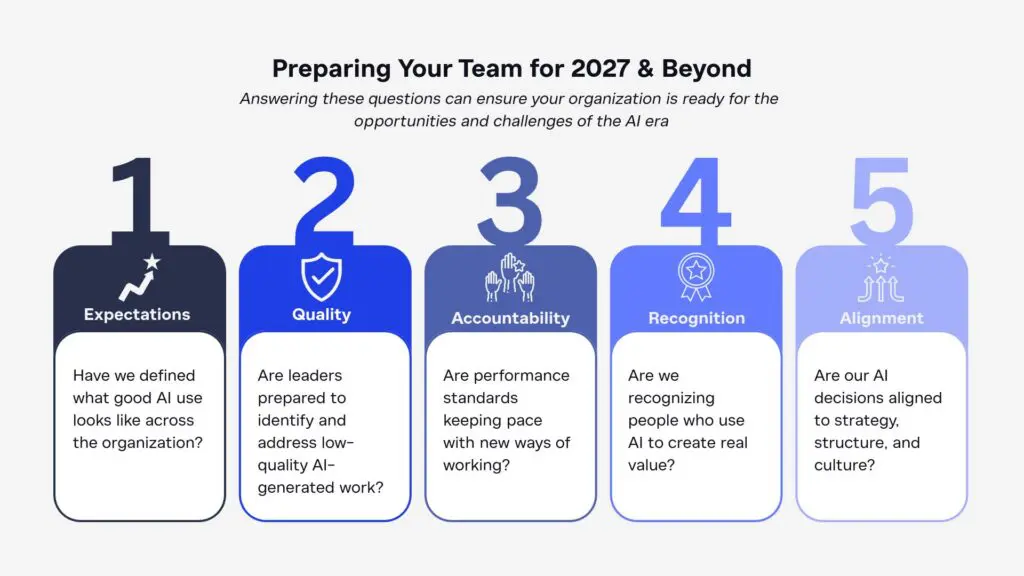
As you plan for the year ahead, ask yourself and your team:
- Expectations: Have we clearly defined what good AI use looks like in our organization?
- Quality: Are leaders equipped to spot and address low-quality, AI-generated work?
- Accountability: Are performance standards keeping pace with how work is produced?
- Recognition: Are we celebrating the people who use AI to deliver real value?
- Alignment: Are our AI choices connected to strategy, structure and culture, or are they happening in isolation?
The question isn’t whether HR has a role in the AI era. It’s how deliberately you choose to lead.