
AI conversations tend to start with the same question: Where can we use it?
There may be a better place to start: If we were designing our organizations today, with the technology and information available to us now, what work would we choose not to recreate?
Organizations accumulate work over time. A report is created to solve a particular problem. A meeting gets added because people need better coordination. A role absorbs a responsibility because someone needs to own it. Another approval gets introduced after something goes wrong.
Individually, each decision can make perfect sense, but years later, we can find ourselves with an organization built around assumptions and constraints that no longer exist.
AI gives leaders a compelling reason to challenge them.
Don’t Just Make the Existing Work Faster
Much of the conversation about AI focuses on productivity. How can we automate this? How can we create something faster? How can we reduce the time it takes?
Those are worthwhile questions. But there is a danger in using powerful new technology simply to accelerate an old way of working.
Before asking how AI could make a process faster, ask something more fundamental:
Should we still be doing this work at all?
What outcome are we trying to achieve? What work actually produces that outcome? What could go away? What becomes more important? And where does human judgment create the most value?
Those are organization design questions.
A Small but Very Real Example
We recently made a simple change to our own commercial meetings at AlignOrg.
For a long time, those meetings included a significant amount of reporting out. One by one, people would share what was happening across their part of the business.
There wasn’t anything inherently wrong with the information. The problem was that we no longer needed the meeting to deliver it.
We had built better reports and dashboards, and the information people needed was already available outside the meeting. Continuing to spend valuable collective time reporting it back to one another no longer made sense.
So, we changed the purpose of the meeting.
Instead of coming prepared to report activity, the conversation centers on opportunities that need strategic direction, roadblocks the group can solve together, cross-functional coordination and managing the funnel.
It was a relatively small change, but it illustrates the larger opportunity in front of organizations right now.
When technology makes information easier to access, don’t simply use the time you save to consume more information. Redesign the work around what people can uniquely contribute.
In this case, the valuable work wasn’t reporting information. It was interpreting it, challenging assumptions, solving problems and deciding what to do next.
AI raises that same question at a much larger scale.
That’s Where Organization Design Comes In
One of the foundational ideas behind AlignOrg’s Cube methodology, introduced in Mastering the Cube, is that an organization is an interconnected system.
You can’t fundamentally change one component and assume everything else should stay the same.
- Change how information flows, and you may need to change how decisions get made.
- Automate part of a process, and roles may need to evolve.
- Change what a role is accountable for, and measures or incentives may need to follow.
- Free people from routine work, and suddenly the organization needs different capabilities to take advantage of that capacity.
One change creates consequences elsewhere in the system.
That’s why dropping AI into an existing process isn’t the same as redesigning the organization around what AI now makes possible.
AI Should Make Us Question the Work
Imagine a process that takes five hours today. The most obvious AI question is: How can we get this down to one hour?
But suppose we step back first. Why does the process exist? Which decisions does it support? Who uses the output? What would happen if parts of it disappeared altogether?
Maybe the opportunity isn’t five hours becoming one. Maybe it’s five hours becoming zero, with an entirely different activity taking its place.
That’s the more interesting organization design question. It’s also where leaders need to resist the temptation to look at AI purely as a technology implementation. Organizations are very good at adding. New technology. New processes. New meetings. New measures. New responsibilities. We’re generally less disciplined about taking things away.
Design From the Future Back
AI creates a rare opportunity to look at the organization with fresh eyes.
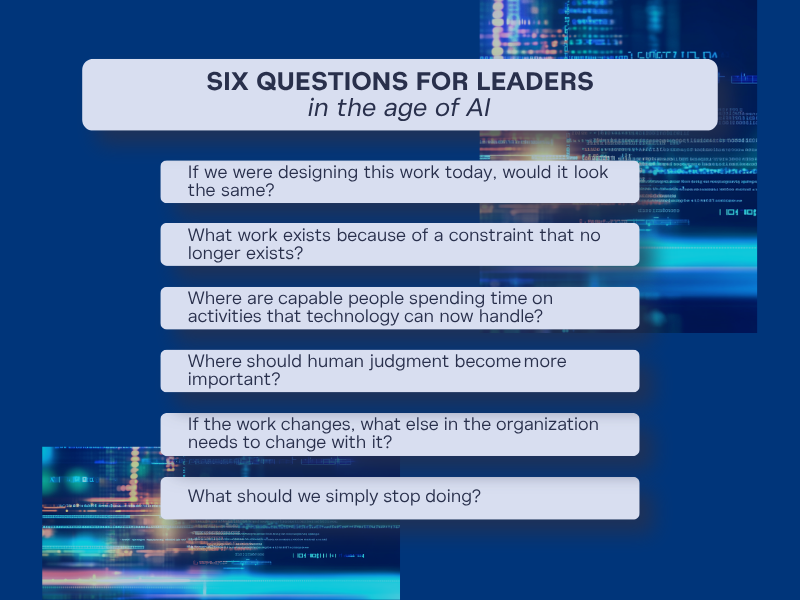
Instead of starting with a list of AI use cases, leaders can ask:
- If we were designing this work today, would it look the same?
- What work exists because of a constraint that no longer exists?
- Where are capable people spending time on activities that technology can now handle?
- Where should human judgment become more important?
- If the work changes, what else in the organization needs to change with it?
- And perhaps most importantly: What should we simply stop doing?
Our commercial meeting didn’t need a faster report-out.
It needed to stop being a report-out.
That’s the distinction leaders should be looking for as AI changes the possibilities around us. The organizations that get the most value from this moment may not be the ones that simply automate the most work. They’ll be the ones willing to redesign the work itself, and then align the organization around it.