
Differentiation by Design
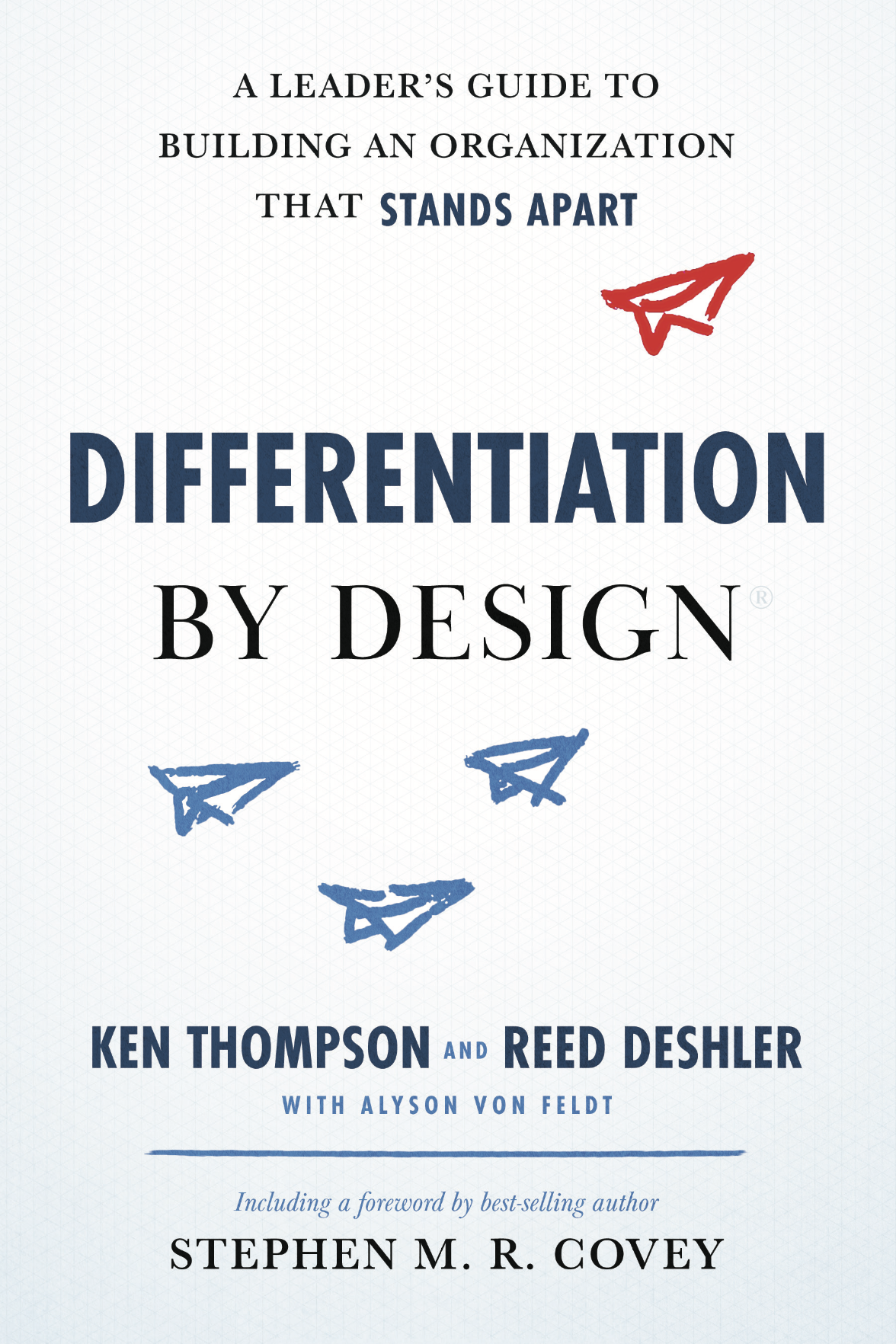
Organizational success doesn’t happen by accident or by luck. It comes when you intentionally design your organization to deliver distinctive value.
Differentiation by Design shares seven fundamentals for defining how your organization will win—and for building an operating model to bring your strategy to life. Learn how to align your organization’s choices and resources, develop leaders capable of holding the line on strategic trade-offs, and create a distinctive culture.
Thompson and Deshler offer leaders a disciplined approach to designing organizations that win because they are built to differentiate.
Differentiation by Design. . . .provides the operating blueprint for aligning talent, culture and leadership to business strategy.
Drawing on decades of real-world experience, this book provides a practical roadmap for transforming an organization to get measurable business results.
Thompson and Deshler blend strategic thinking with practical implementation in a way few authors achieve. Their seven fundamentals offer a powerful framework for leaders navigating disruption, growth, and transformation.
Organizations gain a competitive advantage when every employee understands what matters most and how their work contributes to enterprise success. Thompson and Deshler show leaders how to create that clarity and translate it into organizational performance.
Clear strategy requires clear choices. Differentiation by Design is a compelling guide for leaders who want to sharpen focus, make better tradeoffs, and translate strategic ambition into measurable results.
When priorities are unclear, even the most talented teams struggle to perform at their full potential. Differentiation by Design helps leaders create the clarity, alignment, and focus that enable people and organizations to achieve extraordinary results.
The strongest organizations are built when strategy and people systems reinforce one another. Thompson and Deshler show leaders how to make deliberate organizational choices that create alignment, build capability, and sustain competitive advantage.
Having led large-scale strategic initiatives and organizational transformations, I’ve seen firsthand that defining the strategy is only the beginning. The real value comes from translating that strategy into decisions, actions, and sustained behaviors that create competitive advantage. Thompson and Deshler provide leaders with a practical, disciplined framework for making that translation and turning strategic intent into differentiated performance.
Lasting success comes from disciplined choices, not endless initiatives. Thompson and Deshler offer a practical roadmap for creating strategic clarity and turning intent into execution.
The Seven Fundamentals
Differentiation by Design offers seven fundamentals for connecting your strategy to the way your organization actually works. When your choices work together, your organization becomes harder to copy and faster to adapt. That is how strategy becomes a sustained competitive advantage.
01 | Anchor Your Organization's Strategy
02 | Build Distinctive Superpowers
03 | Design Your Operating Model
04 | Align All Systems
05 | Lead Alignment
06 | Measure Your Strategy
07 | Shape Your Culture
01 | Anchor Your Organization's Strategy
A strategy should do more than establish goals. It should define the customers or audiences you will prioritize, the distinctive value you will deliver, and the choices and trade-offs required to deliver it.
Anchoring your strategy creates the clarity leaders need to make consistent organization design, investment, capability, and operating decisions.
Explore more:
- Related resources:
02 | Build Distinctive Superpowers
Every organization has capabilities. Far fewer have deliberately chosen the few capabilities that make them uniquely effective.
Distinctive superpowers are the organizational capabilities that allow you to deliver your strategic promise in ways competitors struggle to match. The goal isn't to become good at everything. It's to become exceptionally strong at the things that matter most to your differentiation.
03 | Design Your Operating Model
Your operating model should make your strategy visible in the way work actually gets done.
That means looking beyond reporting relationships to determine how value flows through the organization, how critical work connects, where decisions are made, how resources are deployed, and how different parts of the organization work together. An effective operating model helps translate strategic intent into organizational reality.
04 | Align All Systems
Organization design doesn't stop when the structure is defined.
Work processes, organizational structures, governance, information, measures, talent, and other organizational systems all influence how effectively a strategy gets executed. Differentiation becomes much harder when those systems are sending conflicting signals.
05 | Lead Alignment
Strategy sets the direction. Leaders determine whether the organization stays aligned to it.
Leading alignment means making and reinforcing difficult trade-offs, removing barriers to execution, staying engaged as the organization changes, and ensuring leadership decisions consistently support the strategy. Alignment isn't something leaders announce and delegate. It is ongoing leadership work.
06 | Measure Your Strategy
Traditional business metrics are important, but many tell leaders what has already happened.
Differentiating organizations also need measures tied more directly to the strategic value they are attempting to create. Anchoring indicators are measures intended to help leaders understand whether the strategy is taking hold before final business outcomes are fully visible.
07 | Shape Your Culture
Culture shouldn't operate separately from strategy and organization design.
The behaviors that become normal inside an organization are influenced by its systems, leadership interactions, decisions, structures, measures, and everyday ways of working. Rather than starting with abstract statements about the culture you want, start with the strategy: What behaviors does our strategy require, and does the organization consistently reinforce them?
Frequently Asked Questions
Differentiating or Drifting?
Differentiation is the result of deliberate choices that make an organization distinctive in how it creates value. Drift is the gradual accumulation of additions, best practices, and reactive decisions that pull an organization toward what everyone else is doing, even while leaders remain busy and well-intentioned.
Yes. A strategic plan can list financial objectives, priorities, and an inspiring vision without ever answering how the organization will win. Without that answer, leaders lack a basis for prioritizing investments, and drift continues unchecked.
Start with the work, not the structure. Identify which work creates distinctive value and which capabilities enable it before making decisions about reporting lines, centralization, or layers.
AI should be deployed where it strengthens the specific way an organization intends to create value, rather than adopted simply because competitors are using it. The right question is which part of the strategy AI can reinforce, not where AI can be used.
Companies tend to add priorities, capabilities, and initiatives far more readily than they remove them. Without a clear strategy for what differentiates the organization, leaders have little basis for deciding what to stop, so complexity accumulates and focus erodes.