
Picture this: A luxury hotel group, renowned for its white-glove guest experience, decides to modernize. Leadership approves a sweeping AI initiative. Within six months, check-in is fully automated and the concierge desk has been replaced with a chatbot that makes spa reservations and provides restaurant recommendations based on search history.
The results? Mixed. Operational costs drop. But guest satisfaction scores—the hotel’s defining metric for decades—begin to slide. Long-time guests feel processed, not welcomed. The brand’s hallmark sense of personal connection has quietly eroded.
Nobody made a reckless decision. But somewhere between the technology roadmap and the rollout, a critical question went unasked: Which of our capabilities actually make us who we are, and which ones just keep the lights on?
The Real Challenge Isn’t Adopting AI. It’s Knowing Where to Apply It.
Across industries, executives are under real pressure to move quickly on AI. The tools are increasingly accessible, use cases are multiplying and competitors are experimenting broadly. The instinct is to act.
But, as we note in our Executive Guide, Designing AI Into Your Operating Model, “Without clarity, it’s easy to apply AI generically—standardizing what should be distinctive or optimizing what should be reimagined.”
The executives who generate sustained competitive advantage from AI aren’t just moving fastest. They’re moving deliberately to focus AI on the capabilities that reinforce their unique value proposition, not just the areas where automation is easiest.
Start with the Work: Distinguishing Differentiating from Foundational Capabilities
This process starts with understanding the two types of organizational capabilities:
Differentiating capabilities are those that directly shape how customers perceive your value. They reinforce your strategic identity and are the reason clients choose you over alternatives. For the luxury hotel, that’s the personalized guest experience. It means knowing a guest’s preferences before they ask and making them feel recognized rather than processed.
Foundational capabilities are necessary but non-distinctive. Compliance management, billing, inventory tracking and standard reporting all keep the organization running, but they don’t win customers. They’re table stakes.
This distinction matters enormously because it determines where and how AI investments create the highest return:
- Applied to differentiating capabilities, AI should amplify by deepening personalization, enabling real-time responsiveness and extending what your best people can do.
- Applied to foundational capabilities, AI should drive efficiency by reducing cost, increasing consistency and freeing human talent for higher-value work.
Let’s return again to our luxury hotel. AI-powered demand forecasting, automated check-in and housekeeping all belong in the foundational tier. But the personalized guest experience—knowing that a returning guest prefers extra pillows, a quiet room and a late checkout—that’s differentiating. AI here should support and extend human judgment, not replace the warmth that defines the brand.
Match AI Depth to Strategic Intent
Once capabilities are classified, the next step is defining how deeply AI should be integrated. In our guide, we identify three distinct levels of strategic intent:
- Optimize: Automate and streamline existing processes to drive efficiency. Best applied to foundational work.
- Transform: Rethink how work is performed, restructuring workflows and roles to create meaningful differentiation. Suited to high-value, customer-facing capabilities.
- Expand: Unlock entirely new capabilities, insights or value offerings that open new market opportunities.
Each level demands a different investment profile, governance model and organizational design. Mismatching them is where many AI initiatives lose traction. Over-engineering a transactional process with transformative-level AI investments dilutes strategy. Under-investing in differentiating capabilities with basic automation misses the competitive opportunity entirely.
Strategic intent also shapes accountability. When AI is driving transformation in a customer-facing capability, who owns the outcomes? Who decides when AI recommendations are acted on, and when human judgment overrides them? These aren’t IT questions. They’re leadership questions, and they need answers before deployment, not after.
AI Isn’t a Strategy—It’s an Enabler
There’s a pattern in organizations that struggle with AI: they treat it as a strategy in itself. They set adoption targets, track tool deployment metrics and measure success by the number of functions touched. But none of that creates competitive advantage.
AI amplifies what’s already in your system, good or bad. A coherent strategy gets amplified. A fragmented operating model gets more fragmented. An organization with clear differentiating capabilities deepens them. One without strategic clarity standardizes everything, including the things that made it distinctive.
Where to Start
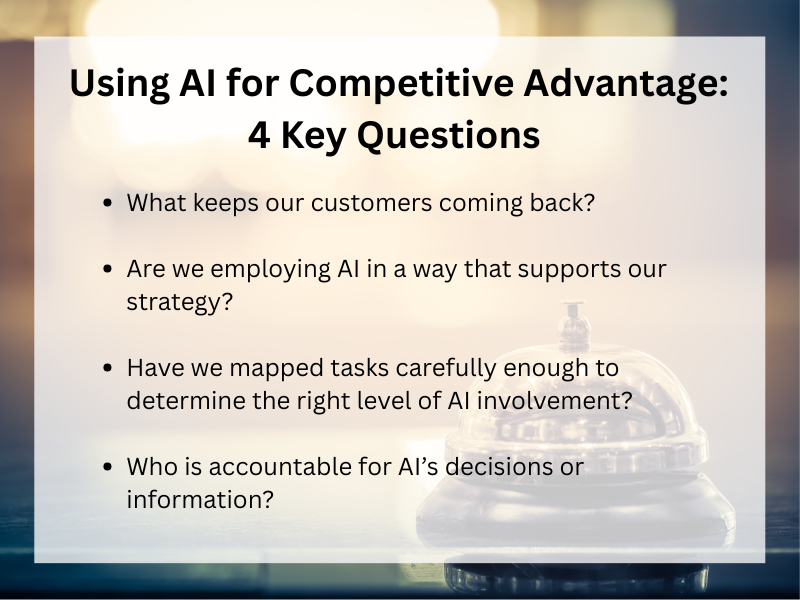
If you’re evaluating or scaling AI integration across your organization, these are the questions worth prioritizing:
- What are our differentiating capabilities? Where does customer perception of our value actually come from?
- Where are we applying AI—and does that match our strategic intent? Are we optimizing foundational work and amplifying differentiation, or accidentally standardizing what should be distinctive?
- What does each type of work demand? Have we mapped tasks carefully enough to determine the right level of AI involvement?
- Who is accountable when AI informs or executes decisions? Are decision rights clear before deployment?
Getting these answers right before scaling AI investment is the difference between building a competitive advantage and building an automated version of the status quo.