
In the first two parts of this series, we made the case for change. We showed how HRBPs become the strategic muscle behind Alignment Leadership—the force multipliers who turn strategic choices into operating models that work. Then we shared a practical roadmap to build that capability, complete with a maturity model and the metrics that prove impact.
Now for the harder question: once you’ve defined the benefits and mapped the roadmap, how do you make sure your HRBPs can consistently perform strategic work? How do you protect that work from risks that can erode it?
Let’s explore six best practices that can enable strategic HRBP work, followed by the five risks most likely to derail it, and how to mitigate them.
Six Best Practices for Enabling Strategic HRBP Work
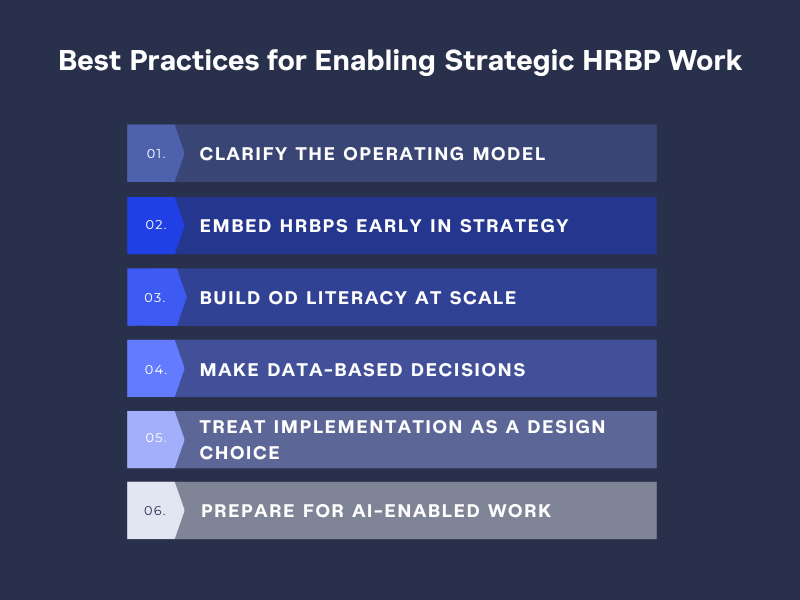
1. Clarify the HR operating model
Strategic work needs room to breathe. Segment your HR function—shared services, centers of excellence (COEs) and HRBPs—so transactional demands don’t crowd out design and activation work. The key is to clearly define the interfaces, not just the boxes. Who owns what and how handoffs happen matter far more than the org chart itself.
2. Embed HRBPs early in strategy
The value of a strategic HRBP shows up in problem framing, not just problem solving. Pull them into the conversation before the solution is chosen. HRBPs who help shape the strategic problem can pressure-test possible solutions from the start, rather than reacting to decisions already made.
3. Build OD literacy at scale
Reclassifying someone as an HRBP does not make them one. Equip your partners with practical, repeatable organization design (OD) tools:
- Operating model design
- Decision rights mapping
- Spans and layers analysis
- Process and work redesign
Then accelerate quality with playbooks, templates and worked examples.
4. Make data the lingua franca
Design by opinion loses to design by evidence every time. Equip HRBPs with talent, organizational and performance insights. Then, train them to translate that data into a diagnostic story leaders can act on. The goal isn’t more dashboards, its sharper decisions made faster.
5. Treat implementation as a design choice
Most transformations don’t fail at strategy, they fail at activation. Design defines the destination; activation is what gets the organization there. Momentum is perishable and a delayed decision or unclear role can quietly drain it.
Invest deliberately in:
- Governance that keeps decisions moving
- Communications that build confidence through consistency
- Staged role phasing that gives people clarity as their work evolves
HRBPs are pivotal to sustainment. They keep momentum going long after the workshops end.
6. Prepare for AI-enabled work
Value pools are shifting fastest where humans and machines now work together. Position your HRBPs as advisors on human-machine collaboration, reskilling and role redesign. Gartner points to this as one of the defining frontiers for the role. HRBPs who can help leaders redraw roles around what AI changes—and what it doesn’t—become indispensable to competitive advantage.
Risks—and How to Mitigate Them
Even a well-designed HRBP function faces threats, but with proper planning, these risks can be minimized or avoided.
Risk: HRBPs overloaded with transactions, starving strategic work.
Mitigation: Clarify HRBP scope explicitly. Route transactional demands to shared services. Set a minimum weekly allocation for strategic activities so design and activation work never become the first casualty of a busy week.
Risk: Design without activation.
Mitigation: Treat activation as a full workstream with named owners, milestones and measures. Equip HRBPs to lead leader enablement and staged role phasing, so a strong blueprint doesn’t stall on the drawing board.
Risk: Data-poor decisions and “design by opinion.”
Mitigation: Standardize a diagnostic pack that grounds every design debate in evidence:
- Capability heat map
- Spans and layers analysis
- Decision latency measures
When the facts are on the table, debates get shorter and choices get better.
Risk: Misaligned incentives.
Mitigation: Align metrics and rewards with collaboration and end-to-end outcomes, not functional sub-optimization. If your talent systems quietly reward siloed wins, no amount of design will produce enterprise results.
Risk: HRBP as “messenger,” not advisor.
Mitigation: Build business acumen and influencing skills and sponsor HRBPs into early-stage strategy conversations. An advisor shapes the decision; a messenger only carries it.
Closing the Loop: From Capability to Competitive Edge
Across this series, the arc has been deliberate. We started with why HRBPs matter as the strategic muscle behind Alignment Leadership. We moved to how you build that muscle through a structured capability roadmap. And here, in this final installment, we’ve focused on what it takes to sustain it—the practices that enable strategic work and the risks that threaten to undermine it.
The through-line is simple: HRBPs don’t become indispensable change partners by accident. They get there when they are:
- Structured correctly—with a clear operating model that frees them for strategic work
- Equipped properly—with OD literacy, data fluency and readiness for AI-enabled change
- Sponsored intentionally—embedded early, given influence and rewarded for enterprise outcomes
Do that, and your HRBPs stop administering HR process and start architecting alignment. They translate strategic intent into operating reality, protect momentum through activation and keep the organization healthy long after the design phase closes.
This concludes our three-part series on HRBPs and Alignment Leadership. Follow us on LinkedIn for more insights on turning strategy into results.