In our previous blog, we explored how HR business partners can serve as the muscle that helps Alignment Leaders® turn strategy into successful operating models. The next question—how do you build that muscle deliberately?
Most organizations already have HRBPs. Far fewer are realizing the benefits of HRBPs that serve as strategic advisors, shaping the design and orchestrating activation. The gap between the two isn’t a mystery of talent—it’s a matter of capability, structure and intent. Let’s explore a practical path to close it.
What Does the Transition from Transactional Partner to Enterprise Architect Look Like?
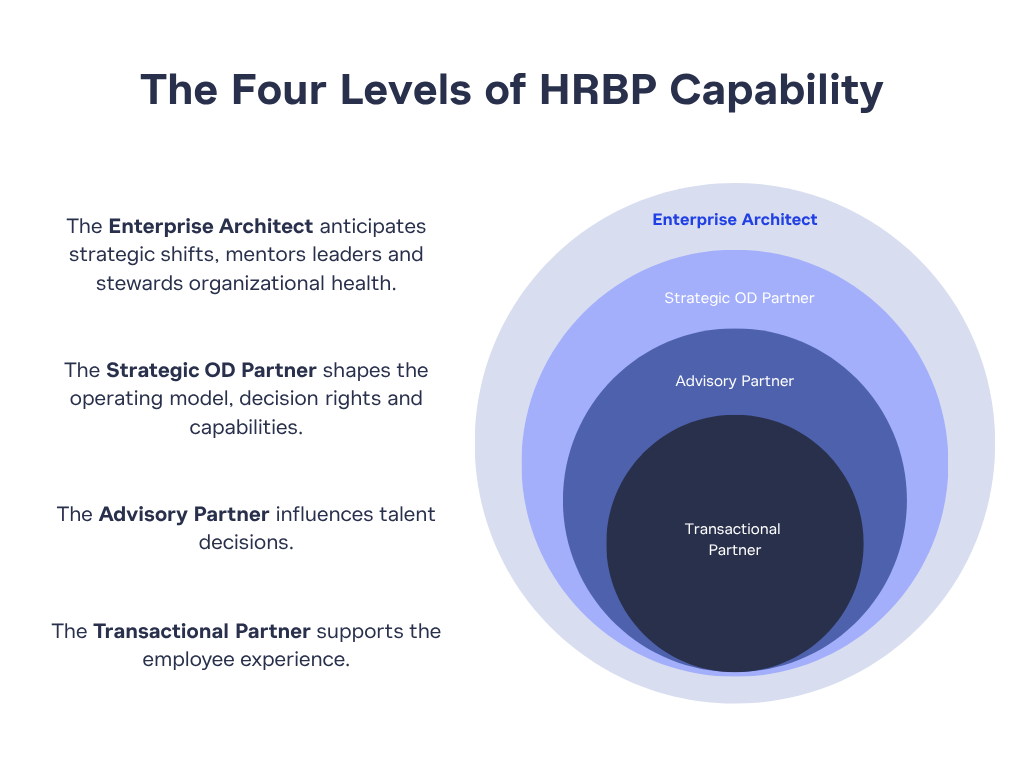
Before you invest in development, you need a clear picture of where your HRBPs stand today. This maturity model below gives leadership a shared language for that conversation—and a target to aim at.
The Four Levels of HRBP Capability
- Level 1: Transactional Partner
Focused on employee relations, compliance and administrative support. Strategic influence is minimal, and most time is spent reacting to day-to-day demands.
- Level 2: Advisory Partner
Participates in planning conversations, uses basic analytics and influences talent decisions. Organization design (OD) contributions happen, but only on an ad hoc basis.
- Level 3: Strategic OD Partner
Co-leads operating model discussions, designs decision rights and shapes capability and workforce strategies. Leads change activation plans that make new designs stick.
- Level 4: Enterprise Architect
Anticipates strategic shifts before they surface, integrates AI and analytics into workforce design, mentors leaders and stewards the organizational health portfolio over time.
Many HRBPs function at Levels 1 and 2, but the strategic value lives at Levels 3 and 4. The roadmap that follows is designed to move your function up that ladder on a predictable timeline.
A Practical Roadmap to Build HRBP Capability
Capability doesn’t develop by accident, and it relies on a solid structure. This 90/180/365-day roadmap sequences the work so momentum builds rather than stalls.
The First 90 Days
The opening quarter is about giving HRBPs the role clarity and practical skills they need to succeed in their strategic positions.
- Role reset. Publish clear HRBP role outcomes and define interfaces with your centers of expertise (COEs) and shared services. Ambiguity about who owns what is one of the fastest ways to stall progress, so remove it early.
- Skill sprint. Conduct OD workshops on operating model design, decision rights and spans and layers—using live business cases, not hypotheticals. Practical repetition builds real capability.
- Strategic embed. Assign HRBPs “design seats” in two to three priority initiatives. Being in the room when trade-offs get made is where influence starts.
The Halfway Point: 180 Days
This is the inflection point where HRBPs shift from observing to shaping how work gets done.
- Partnership rituals. Establish monthly alignment forums with business leaders to review design health and unblock decisions. Consistency here builds the trust that makes partnership durable.
- Analytics uplift. Create a lightweight organizational health dashboard that tracks decision latency, role clarity, handoffs and attrition risk. Keep it simple and visible.
- Shadow-to-lead. Move HRBPs from co-facilitating design sessions to leading them, with coaching alongside. This is where capability converts into visible contribution.
The Finish Line: Day 365
At the one-year mark, the goal is turning individual skill into institutional capability that survives promotions and turnover.
- Certification and community. Formalize an internal OD cohort with practice clinics, playbooks and retrospectives. A peer community accelerates learning across the whole function.
- Scale through playbooks. Institutionalize simple templates—design criteria, decision rights maps and linkage charters—so good practice becomes repeatable.
- Tie to talent systems. Align rewards and development to reinforce new decision rights, collaboration and capability building. If your talent systems don’t reward strategic behavior, you’ll quietly signal that it doesn’t matter.
How Should Leaders Measure HRBP Impact on Organizational Health?
A roadmap is only worth implementing if you can prove it’s working. That calls for a short, disciplined set of metrics in two categories: lagging outcomes help you prove ROI, and leading indicators to help you determine if the transformation is on track.
Outcomes
- Strategy execution. Time-to-decision, time-to-market and throughput on priority initiatives.
- Performance and growth. Productivity, quality and customer impact—plus revenue and profit where the contribution is attributable.
- Engagement and retention. Improved leader and employee sentiment in the areas touched by redesign.
Indicators
- Decision rights clarity. Percentage of your top 10 decisions with a named decide/approve/recommend owner and a clear escalation path.
- Design integrity. Percentage of linkages with defined cadence, inputs and owners, plus measurable reductions in rework and handoff errors.
- Capability readiness. Fill rate of critical roles and demonstrable skill uplift in your differentiating capabilities.
- Adoption. Leader behavior audits, participation in governance forums and completion of role transitions.
These measurements should provide you with a clear look at whether your HRBPs are fulfilling their strategic purpose and helping your organization achieve its strategic goals.
Turning the Roadmap into Reality
A well-designed HRBP model and a well-built HRBP function are not the same thing. This roadmap exists to close that gap—the same gap that separates a strategy on paper from an organization that genuinely operates differently.
The organizations that get this right share three habits. They use the 90/180/365 roadmap deliberately rather than hoping capability appears on its own. They watch leading indicators as closely as lagging ones. And they hold leaders accountable for the handoffs between phases, because that’s precisely where momentum tends to leak.
Do that, and your HRBPs stop being administrators of HR process and become architects of alignment—turning strategic intent into measurable impact, at speed and at scale.
This is Part 2 of our three-part series on HRBPs and Alignment Leadership. Follow us here or on LinkedIn for the next installment.