
Why So Many AI Initiatives Underdeliver
Designing an organization is a lot like building a house. Both have interconnected systems that must work together to deliver a successful outcome. Build a beautiful kitchen but fail to connect the plumbing or electricity properly, and suddenly your renovation becomes the stuff of HGTV nightmares. Create a winning strategy, but if your work, structure, metrics, and culture aren’t aligned to support it, you’ll fall far short of your goal.
The same principle applies to AI. A new layer of technology promises to make life easier but reveals the cracks instead—think a robot vacuum that catches a loose thread and unravels the entire rug. Simply put, AI amplifies whatever’s already in place or missing from your operating model. It increases the speed, reach and efficiency of successful systems, but pulls at the “loose threads” of those that are misaligned or absent. If decision rights are unclear, AI accelerates confusion. If metrics don’t reflect strategic priorities, AI optimizes for the wrong outcomes faster. If AI is integrated only as a task optimizer without redesigning work processes, roles, structure, governance, linkages, etc., it is unlikely to deliver its intended ROI.
Some experts estimate that 80 percent of AI projects fail to deliver their intended value—so how can you make yours part of the slim minority that succeeds? It starts with understanding the role alignment plays in turning strategy into results.
The Hidden Cracks in Your AI Implementation
At AlignOrg, we see organizations as systems of interrelated choices—work processes, structure and governance, information and metrics, people and rewards, continuous alignment, and culture and leadership. Picture these as the six sides of a cube, with strategy sitting at the center. Turn one side of a cube, and every other side shifts with it.
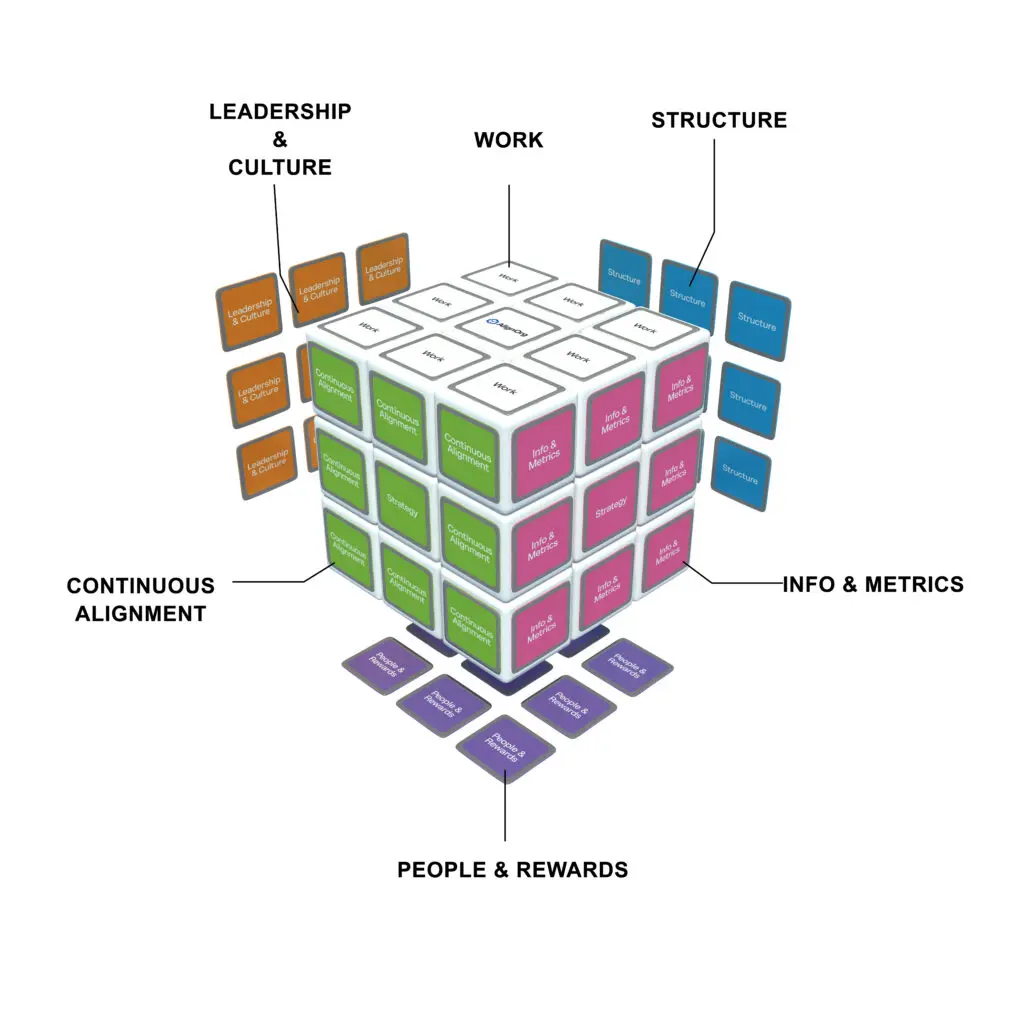
Misalignment occurs when one system (or side of the cube) changes while another part of the organization fails to evolve or adapt. Individually, these changes may seem manageable, but over time, they create organizational friction and quietly erode performance. To see how AI amplifies these misalignments, consider the scenario below.
The organization: A mid-sized commercial insurer with a strong book of business and a growing problem. Faster, tech-forward competitors were winning deals before its underwriters even finished their reviews.
The strategy: Cut policy turnaround from 12 days to 3 and reclaim market share.
The proposal: Implement an AI-driven underwriting platform that could assess risk in seconds rather than days.
The result: Eighteen months and a seven-figure investment later, turnaround times had barely budged, and loss ratios were creeping upward. The technology worked as planned. So, what went wrong?
The Organizational Misalignments AI Exposed:
- Info & Metrics: Underwriters were still compensated on risk accuracy and loss-ratio performance, not speed. They manually re-checked every data point the AI produced, protecting their bonuses while negating the time advantage.
- Leadership & Culture: Leadership failed to communicate a compelling need for a strategy change. With no clear reason to change, employees reverted to the familiar instead of embracing new ways of working.
- Continuous Alignment: Leaders adopted a “one and done” mindset. Once the AI training rollout wrapped, no one went back to evaluate how well the shift was progressing. The misalignments went unnoticed until the business results forced the issue.
Had the organization realigned incentives (Information and Metrics and People and Rewards sides of the cube), engaged its people, and built in regular checkpoints (Continuous Alignment and Leadership and Culture sides of the cube), the AI platform could have delivered the speed it promised. The lesson is simple: systems alignment isn’t a follow-up to AI adoption. It’s the precondition for its ultimate success.
Who Owns Alignment?
Navigating these complexities requires leaders whose role is to keep the organization’s architecture (operating model) aligned with its strategy. We call these people Alignment Leaders®. To do their work effectively, Alignment Leaders must draw on four core competencies:
- They make deliberate trade-offs and choices. Rather than trying to do everything at once, they decide what the organization will say yes to—and, just as importantly, what it will direct resources away from to accomplish those goals. With AI, this means deciding which use cases best support strategy, and which existing investments must be scaled back to fund them.
- They ensure alignment across every system, or side of the cube. Alignment Leaders look across work, metrics, structure and governance, people and rewards, and leadership and culture to ensure every aspect of the organization is working together to accomplish its strategy. As we saw in the example above, AI impacts are rarely contained to one area of an organization. They ripple across the system, requiring a leader with a holistic view to spot the changes needed to maintain alignment.
- They drive change effectively. Alignment Leaders move beyond announcements and slide decks, embodying new behaviors and ensuring stakeholders understand the rationale and tradeoffs behind the decisions. When introducing AI, this includes helping teams understand not just what is changing, but why the shift matters and what it means for their day-to-day work.
- They build these capabilities in others. They ensure alignment doesn’t depend on one individual, so the organization can maintain it long after any single project ends. As AI continues to evolve, organizations need leaders at every level who can keep strategy and architecture in step with ongoing technological change.
Leaders who skip this groundwork often make the same mistake: they rush to deploy AI tools and hope the organization’s architecture will somehow catch up. It never does. The cracks simply widen and the investment stalls. Systems alignment must lead, and technology must follow, not the other way around.
Fix the Organization, Not Just the Tech
AI will expose what’s misaligned in your organization, whether you’re ready for that visibility or not. The executives who benefit most from AI aren’t the ones with the biggest technology budgets; they’re the ones who treat systems alignment (sides of the cube) as critical, ongoing work.
Before your next AI investment decision, ask: Is our organization already aligned to the outcome we want? If the honest answer is no, that’s the work to prioritize first. Reviewing your organization’s alignment against its strategic goals is a faster path to AI ROI than any new tool on the market.
To learn more about incorporating AI into your organization with strategic intent, read our new Executive Guide, Designing AI Into Your Operating Model.