When companies need to reduce costs, the math can seem straightforward. Usually, it’s an executive announcing something like, “Every function needs to reduce headcount by 10%.”
From there, things unfold predictably. Finance gets a target, leaders identify positions and boxes disappear from the org chart.
There’s just one factor that often goes unconsidered. The work itself doesn’t disappear. That’s how organizations become Swiss cheese.
How the Holes Form
A role is eliminated here. A team gets smaller there. Another layer is removed somewhere else. Each decision looks reasonable on its own, but together they leave a Swiss cheese organization full of holes, but with largely the same expectations:
The same meetings.
The same reports.
The same approvals.
The same customers to serve.
The same internal requests.
The same service levels.
The same priorities.
Except now, there are fewer people trying to do all of it. That isn’t organization design, it’s subtraction.
It’s easy to see why leaders choose the solution that feels the most fair. Letting employees go is difficult for everyone involved, and if each team has to share a bit of the pain, no team will bear an unjust burden. To proceed in that manner, however, ignores a key truth. Not all work is equally valuable. Consider this example:
A boutique hotel is known for its attention to detail. They put mints on the pillow, keep immaculate rooms and offer turndown service.
After running the numbers, executives decide that costs must be cut and each department will lose 15 percent of its staff. The math is clean, and the reductions feel balanced. But the details that made the hotel special all depend on its housekeeping employees. With fewer hands, those details quickly disappear. No more mints or turndown service. Rooms that are tidy but never spotless.
As you can guess, it doesn’t take long for guests to notice and adjust their behavior accordingly. Loyalty slips, and revenue follows. The cost savings that looked so good on a spreadsheet are consumed by declining occupancy. In short, the cuts that were supposed to save money ended up taking everything that made the hotel unique.
What Leaders Must Ask
The point is that a reduction in staff must force a critical conversation:
If we are going to have fewer people, what work are we going to do differently?
Not just who goes? but:
- What will we stop doing?
- What will we intentionally do less of?
- Where will we lower service levels?
- What can we standardize or simplify?
- What work can be automated or enabled differently?
- What work should move to create scale or eliminate duplication?
- What decisions, approvals, meetings and handoffs can we remove?
- Where do we need to protect capacity because the work is strategically differentiating?
The goal shouldn’t be to make the same organization 10% smaller. It should be to design an organization that can successfully operate with 10% less capacity. The first shrinks the organization you have, while the second builds the organization that you need.
Rethink the Work Before You Redraw the Org Chart
To revisit our boutique hotel: If leadership would have approached the cuts strategically, the outcome could have been much different. They would have realized that their housekeeping differentiates the hotel from others in the market. Rather than cut that staff, they’d focus their reductions in other areas while doubling down on the strategically important work that kept guests coming back for more.
Remember, if you reduce people without redesigning the work, the remaining employees become the connective tissue filling every hole.
They run faster.
They stretch across roles.
They attend more meetings.
They pick up orphaned work.
And they keep trying to deliver yesterday’s promises with today’s capacity.
Eventually, something gives.
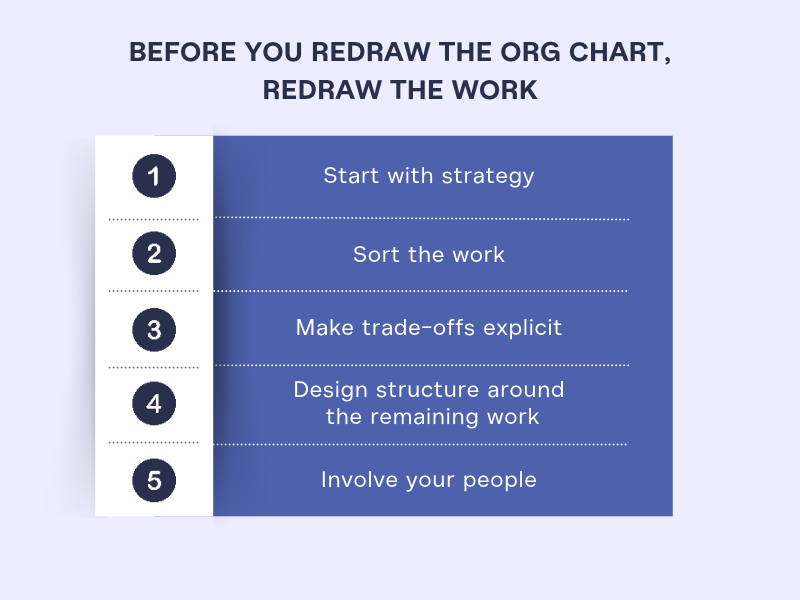
So before you redraw the org chart, redraw the work:
- Start with strategy. Clarify which capabilities drive your competitive advantage.
- Sort the work. Separate what’s strategic, what’s necessary and what’s no longer needed.
- Make the trade-offs explicit. Decide what stops, what slows and what gets protected, then communicate it clearly.
- Design structure around the remaining work. Only then decide roles and headcount.
- Involve your people. Teams are more likely to support changes they helped shape.
Cost reduction starts with a number. Organization design starts with a choice about the work. Make that choice deliberately, and you build an organization that is smaller and stronger. Skip it, and you get Swiss cheese.