
Observations from organizations navigating growth, complexity and changing capabilities
Across the life sciences sector, common questions are emerging as organizations navigate growth, complexity and changing capabilities.
Our experience spans biopharma, biotech, medtech, medical devices, diagnostics and life sciences, with organizations at very different points in their evolution. Some are expanding into new parts of the value chain. Others are managing increasingly complex portfolios, integrating acquisitions, building enterprise platforms or exploring how AI may reshape work.
The specific organizational challenges vary. What is striking, however, is how often the underlying questions are similar:
- What capabilities should we own?
- Where should they sit?
- What should be shared across the enterprise?
- Where does business-unit autonomy create value?
- How should functions come together around products or assets?
- How does AI change the way decisions are organized?
- And, perhaps most fundamentally, who should make which decisions?
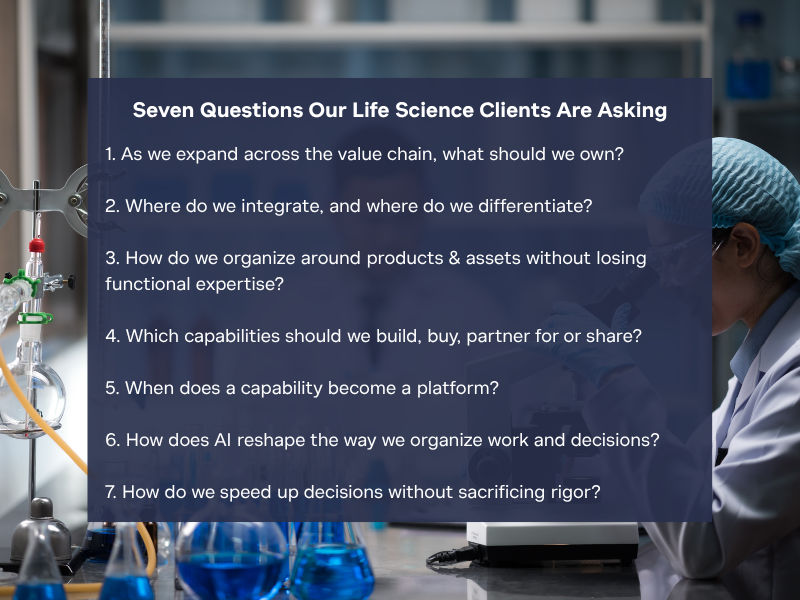
Let’s explore these seven common questions in more detail.
1. As we expand across the value chain, what should we own?
Life sciences organizations are moving beyond their historical areas of focus. Depending on the organization, that can mean adding manufacturing capabilities, diagnostics, clinical support, patient services, data and analytics, digital capabilities or other adjacent offerings.
The strategic rationale can vary, but the organizational implications are often similar.
Adding a capability is not simply a matter of adding people or creating a new function. It can introduce new interfaces, new expertise, new decision rights and new dependencies across the organization.
This creates an important question:
Which capabilities are becoming strategically important enough to differentiate, and which can be delivered effectively through partners or the broader ecosystem?
Organizations often find that the answer is not binary. Some capabilities may need to be deeply owned internally, while others may be accessed through partnerships, outsourcing, acquisitions or shared platforms.
The operating-model challenge is determining where ownership creates meaningful strategic value and where it simply creates additional organizational complexity. That distinction carries real consequences: owning the right capabilities can sharpen differentiation and accelerate speed to market, while owning the wrong ones drains resources, slows execution and delivers little in return. Getting this call right, and revisiting it as the business evolves, is where much of the value is won or lost.
2. As our portfolio matures, where should we integrate and where should we differentiate?
Many large life sciences organizations have already evolved into portfolio models through acquisitions, therapeutic areas, franchises, platforms, business units or geographic expansion.
Once that portfolio is established, another question emerges:
How much should the enterprise operate as one company, and where should individual businesses retain autonomy?
We see organizations navigating a familiar set of tensions:
- Enterprise scale and business-unit autonomy
- Standardization and flexibility
- Shared capabilities and differentiated capabilities
- Enterprise governance and speed of decision-making
- Common platforms and business-specific requirements
There is no universal answer. What makes sense depends on where value is created, where expertise resides, where scale matters and where differences between businesses are strategically meaningful.
The right balance can change as a portfolio matures. The organizational choices that make sense during acquisition or rapid expansion may look very different once businesses, capabilities and platforms become more established. Organizations that design fluidly can adjust as the market shifts. They’re better able to absorb new capabilities and new technologies without triggering a disruptive, top-to-bottom reorganization every few years. That agility protects speed to market and preserves momentum when conditions change quickly.
3. How do we organize around products and assets without losing functional expertise?
We are seeing increasing interest in bringing technical, scientific, medical, commercial, manufacturing and operational capabilities together around products, assets, programs or therapeutic areas.
The intent is straightforward: create greater end-to-end accountability, improve alignment and reduce the friction that can occur when important decisions cross functional boundaries.
But bringing people together around an asset does not eliminate the need for deep functional expertise.
It raises a different question:
What should be organized around the product or asset, and what should remain organized around the function?
This creates a balance between functional depth and end-to-end accountability.
The organizational structure is only part of the equation. The more consequential questions often involve who owns the outcome, who owns the expertise, who makes tradeoffs and how disagreements are resolved when functional and product priorities diverge.
In that sense, cross-functional operating models are as much about decision rights and interfaces as they are about reporting relationships.
4. Which capabilities should we build, buy, partner for, or share?
“Make vs. buy” has traditionally been framed as a sourcing or cost question.
Increasingly, it is also an operating-model question.
As capabilities become more specialized, organizations are considering not only whether they can perform the work internally, but how much organizational capability they actually need to own.
The choices can span a broader spectrum:
Build internally → acquire → partner → outsource →divest →access through an enterprise platform
The answer can also change over time.
A capability that begins as an outsourced service may become strategically important enough to develop internally. Conversely, an internally developed capability may eventually become something the organization can access more efficiently through a partner or shared platform.
The recurring question is therefore less about whether something is “make” or “buy” and more about:
Where do we need to own the expertise, decisions and organizational muscle ourselves?
That distinction becomes particularly important when a capability has implications for differentiation, intellectual property, speed, risk or long-term strategic flexibility.
5. When does a capability become a platform?
We’re also seeing movement away from repeatedly building capabilities around individual programs or businesses. Instead, organizations are creating reusable enterprise capabilities and platforms.
This can occur across areas such as manufacturing, clinical operations, data, technology, analytics and scientific capabilities.
The underlying idea is compelling: build something once, establish scale and expertise and allow multiple parts of the organization to benefit.
But platform models introduce a different set of operating-model questions:
- Who owns the platform?
- Who funds it?
- Who determines priorities?
- How do businesses influence the roadmap?
- Who establishes standards?
- What happens when the needs of one business conflict with the needs of the broader enterprise?
A platform therefore changes more than where a capability sits.
Once multiple businesses depend on a shared capability, the organization needs mechanisms for making enterprise-level decisions about that capability.
In this sense, platformization is as much an operating-model decision as it is a technology or capability decision.
6. How does AI change the way work and decisions are organized?
AI is generating significant discussion across life sciences, but one key question extends beyond the technology itself.
If AI changes how work gets done, what happens to the way that work is organized?
The implications could extend across several dimensions:
Work: What activities change, accelerate, or become automated?
Capabilities: What new expertise becomes important?
Structure: Where do those capabilities reside?
Decision-making: Which decisions can be augmented by AI, and which require human judgment and accountability?
Governance: What new controls, oversight and risk-management mechanisms are required?
One possibility is that AI’s organizational impact will not come primarily from eliminating entire functions. Instead, it may change the boundaries between roles, functions and capabilities.
That could make existing operating-model choices more visible.
Where work currently moves through multiple handoffs, where decisions are fragmented, or where expertise is difficult to access, AI may create opportunities to rethink how those connections work.
7. How do we increase decision speed while maintaining rigor?
For life sciences organizations, organizational agility has a particular constraint: speed matters, but so do quality, safety, scientific rigor, regulatory requirements and risk management.
That makes governance an especially important operating-model question.
The challenge is not simply to reduce governance.
It is to understand:
Which decisions need enterprise oversight? Which can be made closer to the work? Who has the authority to decide? And when does a decision need to be escalated?
We are seeing organizations revisit decision rights, governance forums, approval processes and escalation paths with this in mind.
One observation is that greater agility does not necessarily require fewer controls.
It can instead come from clearer decision rights, fewer unnecessary handoffs and greater clarity about which decisions require escalation.
For organizations operating in highly regulated environments, that distinction can be particularly important.
What connects these questions?
While these seven questions appear different on the surface, they point toward a common challenge.
Life sciences organizations are increasingly designing around capabilities and the connections between them, rather than simply around functions or organizational boxes.
As capabilities expand, portfolios mature, platforms emerge, partnerships increase and technology changes the nature of work, organizations must continually make choices about four things:
Integration: Where does bringing capabilities together create value?
Differentiation: Where does the organization need specialized capabilities or autonomy?
Ownership: What should be built and maintained internally versus accessed through the ecosystem?
Decision rights: Who needs to make which decisions, and at what level?
There’s no single operating model that works across biopharma, biotech, medtech, medical devices, diagnostics and life sciences. Even organizations within the same sector can have very different strategic priorities and organizational needs.
What appears more consistent are the questions leaders are having to navigate.
The answers will vary. But increasingly, the ability to make those choices deliberately, and to evolve them as the organization changes, may be as important as the organizational structure itself.
The operating model is ultimately not just a question of where capabilities sit, but how those capabilities, accountabilities and decisions work together to create value.