
CIOs, CTOs, and those responsible for enterprise technology have been handed a deceptively simple mandate: figure out AI. So they do. They identify promising use cases, work through the technology, security, and data questions, deploy solutions, and help people adopt them.
Then they start hearing:
“This saves me a ton of time.”
“I used to do this manually.”
“This gets me 80 percent of the way there.”
Those are great signals. The technology is working, people are using it, and productivity is improving. But eventually, someone asks a different question: “What are we getting for our investment?”
As head of technology for AlignOrg Solutions, I’ve found myself thinking a lot about the gap between those two conversations. And I’m not alone. Research from the MIT Initiative on the Digital Economy found that by the end of 2025, only 11% of S&P 500 companies had deeply embedded AI into their businesses, while 45% were still running pilots.
The challenge isn’t simply finding a better solution, agent, platform, or architecture. Nor is it finding better ways to measure AI activity. The bigger question is: What has to change in the organization for AI productivity to become enterprise value?
I’m increasingly convinced that the next phase of AI isn’t just about deploying better technology. It’s about redesigning the organization around what AI makes possible.
Productivity Is Not the Same as Enterprise Value
Most AI adoption begins at the individual level. An employee uses AI to create a first draft, summarize research, analyze data, prepare for a meeting, or automate a repetitive task. The time savings can be significant.
But saving an individual two hours does not automatically create two hours of enterprise value. If the same work still passes through the same approvals, involves the same meetings, requires the same layers of review, and operates within the same staffing model, the organization may simply have made one task faster without changing the system around it.
Recent research shows just how real, and limited, individual productivity gains can be. A six-month field experiment involving 7,137 knowledge workers across 66 firms found that employees who used a generative AI tool spent two fewer hours per week on email and reduced work outside normal hours. Yet researchers did not detect broader shifts in the quantity or composition of their work from individual-level AI adoption.
That distinction matters. AI can create productivity at the task level. Capturing that productivity as enterprise value requires something else: redesigning how the work gets done.
Deploying AI is a technology initiative. Capturing its value is an organization design choice.
The Question Needs to Change
Most organizations begin their AI journey by asking: Where can we use AI? That’s a reasonable place to start. It encourages experimentation and helps people understand what the technology can do.
But as organizations move beyond pilots and individual productivity, the question needs to change: How should this work be performed now that AI is available?
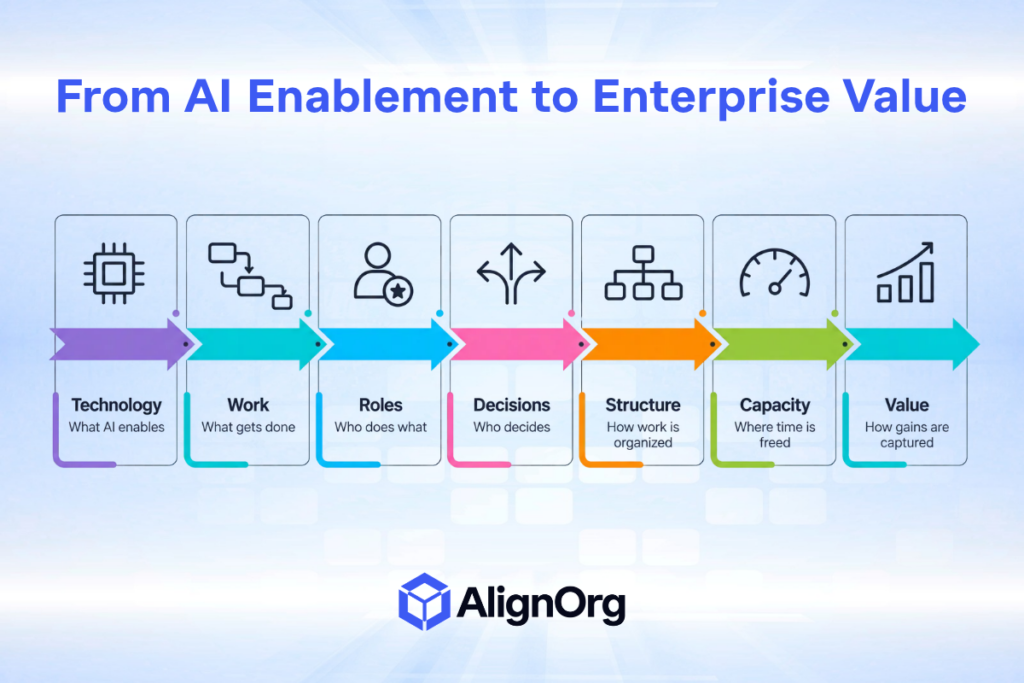
That shift is important. Once AI changes what is possible, it may also change the optimal design of the work around it. The path to value starts to look something like this: Technology → Work → Roles → Decisions → Structure → Capacity → Value
If an organization changes the technology but leaves everything else intact, much of the potential value gets trapped between the first and last steps.
Five Questions for Moving From Productivity to Value
When AI becomes capable of performing meaningful portions of work, leaders should step back and reconsider the system around that work. I would start with five questions:
1. What work should AI perform?
Not simply, “What can AI do?” AI may be capable of performing a task without it being appropriate or valuable for AI to own it. Identify the work where AI can meaningfully improve speed, quality, consistency, scale, or insight.
2. What work should people perform?
As AI takes on more activity, the human role should not simply become “review what the AI did.” Look deliberately at where people add the most value: judgment, context, relationships, exceptions, creativity, accountability, and decisions where nuance matters. The goal isn’t to remove people from work. It’s to make better choices about where human contribution matters most.
3. How should the end-to-end workflow change?
Automating one task inside an unchanged process rarely captures the full opportunity. If AI eliminates several hours of analysis but the output still waits three days for review, the bottleneck simply moves elsewhere. Look across the entire workflow. Which steps can disappear? Which can happen simultaneously? Which handoffs no longer make sense? Where can decisions happen faster?
4. How should decision rights and governance change?
When AI becomes part of the work, leaders need to clarify who makes decisions, when human review is required, what AI can do autonomously, and who owns the outcome. Governance should provide enough control to manage risk without creating so many checkpoints that the productivity gains disappear.
5. How will the organization capture the value?
This may be the most overlooked question. Suppose AI makes a team 20% more productive. What happens to that 20%? Does the organization increase throughput? Shorten cycle time? Improve service? Absorb growth without adding headcount? Redeploy capacity to higher-value work? Reduce cost? Unless leaders explicitly decide how improved productivity will translate into a business outcome, the value can easily disappear into the existing organization.
What We’ve Learned From Using AI Ourselves
We’ve experienced this challenge firsthand at AlignOrg. One area where we’ve been experimenting with AI is presentation development. We can give AI our PowerPoint templates, brand colors, voice, and style guidelines and significantly reduce the time required to create a first draft. That is real productivity.
But we’ve also learned that producing the slides faster isn’t the same as completing the work faster. AI can follow our brand standards, but it doesn’t eliminate the judgment required around how a presentation will actually be used. If the deck references a client by name, someone still needs to determine whether that is appropriate. If we’re creating a joint presentation with a partner, the output has to account for both organizations’ brand requirements. If we’re creating something for a client, their templates, terminology, confidentiality expectations, and brand guidelines may matter as much as ours.
There are other questions as well. Is the content factually accurate? Does the story make sense for this particular audience? Is the information current? Are we using client examples appropriately? Does someone have the authority to approve the final external communication?
AI can accelerate content development, but those decisions still require context, judgment, and accountability. Our initial instinct could be to leave the process untouched: AI creates the presentation faster, and everything proceeds through the same review and approval steps it did before. But that raises a more interesting question: If AI has changed the work of creating the presentation, should we also change the process around it?
Perhaps the first draft no longer requires the same amount of production time. Perhaps review should focus less on formatting and basic content creation and more on accuracy, audience, client context, confidentiality, and brand risk. Perhaps some types of presentations need very little review while client-facing or co-branded materials warrant considerably more.
The important point is that the technology doesn’t make those choices for us. AI changed our capacity to produce the work. Capturing the value requires us to reconsider the workflow, roles, review points, and decisions surrounding it. That’s the difference between using AI to make an existing task faster and redesigning work around what AI now makes possible.
AI Changes the Economics of Organization Design
For decades, many organizational structures have reflected the economics of human coordination. We created layers of management to review work, specialized roles to perform scarce expertise, teams to aggregate information, and processes to manage handoffs between groups.
AI changes some of those economics. It can also expose organizational misalignments that were already there. AI can amplify unclear decision rights, inefficient workflows, and other weaknesses in the operating model. But exposing those issues is only part of the opportunity. AI also gives leaders a reason to reconsider how the organization should work now that the underlying economics of work have changed.
Expertise can become more widely available. Information can move faster. Routine analysis can happen almost instantly. People may be able to manage larger scopes of work because AI handles portions of the coordination and preparation. But those benefits don’t appear automatically. If organizations layer AI on top of existing structures without reconsidering the work underneath them, they risk creating faster employees inside an organization that operates at essentially the same speed.
The Next Phase of AI Is an Organization Design Challenge
One of the biggest lessons I’ve taken from our own AI journey is that deployment is only the beginning. Giving people access, developing use cases, building confidence, and learning what AI can do are necessary steps. But they’re not where the value story ends.
Leaders now need to determine how workflows, roles, decisions, structures, capabilities, and measures should change because AI exists. That requires technology leaders, business leaders, HR, operations, and organization design to work together. The question is no longer simply: How do we deploy AI across the organization? It is: How should we design the organization around what AI now makes possible?
AI does not create ROI simply by doing old work faster. It creates ROI when leaders redesign the organization around what is now possible.