
Most AI enablement plans treat resistance as a training problem. If we just explain the tool well enough, run enough workshops, share enough internal demos, adoption will follow. It usually does not.
A growing body of research in behavioral science and organization design suggests that the limiting factor is rarely the explanation. It is the psychology of the person on the receiving end of the change.
The Four Reasons People Resist
Recent research from Harvard Business Review introduces a useful concept: psychological debt. Drawing on a survey of 1,200 employees across sectors, Guy Champniss of IE Business School identifies six negative effects of AI that suppress adoption:
- Cognitive offloading
- Reduced autonomy
- Diminished competence
- Weakened social connection
- Credibility loss
- Identity threat
This mental burden, which Champniss refers to as “psychological debt,” was strongly associated with lower AI usage, even when employees acknowledged the tool’s value.
Underneath those findings sit four recurring responses that deserve dedicated attention.
Identity Threat
Your highest performers tend to be the most resistant, because their professional identity is built on a particular expertise that an AI model now replicates in seconds. A senior analyst who spent 15 years learning to read a balance sheet does not greet a tool that summarizes one in 20 seconds as a productivity gain. They see it as a question about their continued relevance.
Loss of Autonomy
AI adoption frequently moves an employee from being the originator of work to being the reviewer of work the model produced. That shift sounds neutral on a slide. In practice, it removes the sense of authorship that made the role satisfying in the first place.
Algorithm Aversion
Algorithm aversion is a well-documented effect from the Wharton research of Dietvorst, Simmons and Massey. People judge algorithmic errors much more harshly than identical mistakes made by humans. After a single visible AI miss, trust collapses, and even when the algorithm continues to outperform the human, the user reverts to the human.
Loss of a Skill Ramp
Junior employees who use AI to do work they have not yet learned to do themselves may produce competent output in year one and arrive at year five with no underlying judgment to fall back on. Many sense this and quietly push back, even if they cannot articulate why.
How Leaders Can Bring People Around
The change management literature, particularly the Prosci ADKAR model, has been adapting these ideas to AI for two years. A consistent pattern emerges.
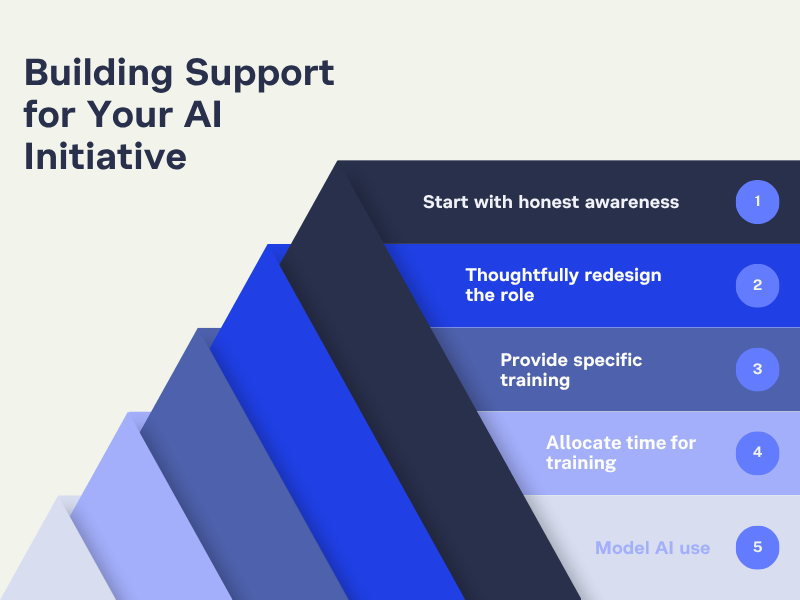
Start with honest awareness
Employees can tell when an AI rollout is cost reduction wearing a different jacket. They respond better to the truth: that the organization expects to do different work, that some tasks will disappear, and that the company is investing in helping them move toward the work that remains valuable.
Build desire by changing the role, not just adding a tool
The leaders who get adoption do not bolt AI onto an existing job description. They redesign the role around the new division of labor and show how the human contribution becomes more interesting, not less.
Provide knowledge tailored to function
A finance team and a marketing team need different prompts, and different prompts produce different outputs. Generic training delivers generic confidence. Specific training, ideally delivered by a peer who already uses the tool well, builds belief faster than any town hall.
Create ability through protected practice
Employees rarely have spare hours in their week to learn a new tool. Adoption rates rise significantly when leadership funds explicit time for practice, ideally with a sandbox where mistakes do not have consequences.
Reinforce through visible leader use
If executives are not using the tool, no one believes the rollout is serious. The single best predictor of middle-manager adoption is whether their own leader uses the tool in front of them.
The One Principle to Remember When Planning AI Transformation
People do not resist change. They resist loss. AI enablement that recognizes what each person is being asked to give up, whether status, autonomy, mastery or identity, and addresses it directly, will outperform any rollout that treats those concerns as friction to be overcome.
Pitfalls Worth Avoiding
No plan will ever be perfect, but there are some common mistakes to be avoided when implementing an AI change management strategy.
The first is treating AI as a tool deployment. Tools are installed. Capabilities are built. The two require different budgets, different timelines and different leaders.
The second is mandating adoption from the top without building psychological safety underneath. When people fear being penalized for not using AI well, they pretend to use it. Pretend-adoption looks the same on the dashboard as real adoption, but produces none of the value.
The third, and the most subtle, is removing the human’s role rather than enhancing it. When AI is positioned as the replacement, the user becomes the auditor of work they used to produce. When AI is positioned as the colleague, the user remains the author. The same tool, in the same organization, will produce opposite adoption outcomes depending on which framing the leader chooses.
Solving for the Human Side of AI Enablement
The technology question in AI transformation is largely solved. The psychology question is not. Organizations that approach AI enablement as a change management exercise, with the same care given to identity, autonomy and confidence as is given to data and models, will continue to pull away from those that approach it as procurement.