
Leadership teams think they’re aligned. They’re usually not.
You’re in an important strategy meeting. The top leaders in your company are in attendance; everyone is focused and you’re all in agreement on the next steps for your company. You shake hands and walk out the door, excited to see the pieces of this bold new plan fall into place.
Fast forward six months later…nothing. No visible changes to the way work is being done. The revenue needle has barely moved, and those big plans the C-suite was so excited about? It’s like they never existed.
What happened?
In a world where business pressures are higher than ever and time is limited, why do so many strategy meetings fail to yield meaningful results? The answer is simple. Your leadership team was not truly aligned.
This is a pattern I see across organizations, regardless of industry or size. Leadership teams are not lacking in intelligence or intent. More often, they are mistaking agreement for alignment—and that distinction is where execution begins to break down.
The Illusion of Alignment
Agreement is relatively easy to achieve, especially among experienced leaders who understand the business and can quickly converge on a strategic direction. Alignment is something else entirely.
Agreement happens in the room. Alignment shows up in the daily work across functions, decisions and priorities.
What I see repeatedly is leadership teams reaching consensus on where they want to go, without fully working through what that direction requires. The harder conversations about tradeoffs, implications and changes to how the organization operates are often abbreviated or avoided altogether. As a result, the strategy exists, but it doesn’t reshape the system.
On the surface, the team appears aligned. Underneath, there are gaps in understanding, in ownership and in follow-through.
Those gaps tend to show up in predictable ways.
Where Alignment Breaks Down
The “Smile-and-Nod”
A new strategic priority is introduced. Leaders listen, nod in agreement and raise few questions. The room moves quickly to next steps.
But months later, little has changed.
What’s missing is not comprehension—it’s commitment to the tradeoffs. Real alignment requires leaders to be explicit about what will stop, what will slow down and what must give way to support the new direction. Without that clarity, people continue to operate as they always have.
Good on Paper, Not in Practice
The strategy makes sense intellectually. Leaders agree it’s the right path for the organization. But as execution begins, the momentum fades and teams gradually fall back into old habits.
The issue isn’t the strategy itself—it’s the lack of translation into how work gets done. Processes, decision rights, performance metrics and cross-functional interactions remain largely unchanged. When the system of work doesn’t shift, behavior doesn’t shift either, regardless of how compelling the strategy may be.
The “Secret Society”
A small group of leaders defines the strategy behind closed doors. The broader leadership team is briefed afterward.
While the message may be communicated clearly, true ownership never expands beyond the original group. The leaders responsible for carrying the strategy into the business weren’t part of shaping it, and as a result, their level of commitment and understanding is limited.
There is a simple principle at play here—one we highlight in Mastering the Cube: people are far more likely to embrace what they help create. When involvement is narrow, alignment will be as well.
Leadership Says One Thing, Does Another
Leaders communicate a new strategic direction, but their behavior doesn’t fully reflect it. Priorities remain crowded. Time is spent in the same ways. Decisions continue to follow familiar patterns.
Employees notice these inconsistencies quickly.
And when they do, they take their cues from what leaders do, not what they say. Over time, this creates mixed signals across the organization, weakening confidence in the strategy and slowing momentum.
Alignment Is a Discipline
Alignment does not happen because a leadership team reaches agreement in a meeting.
It happens when shared intent is translated into shared action—consistently and visibly, across the organization. That requires more than clarity on direction. It requires deliberate choices about how the organization will operate differently in support of that strategy.
In my experience, there are a few practices that meaningfully improve a leadership team’s ability to move from agreement to alignment.
What Real Alignment Requires
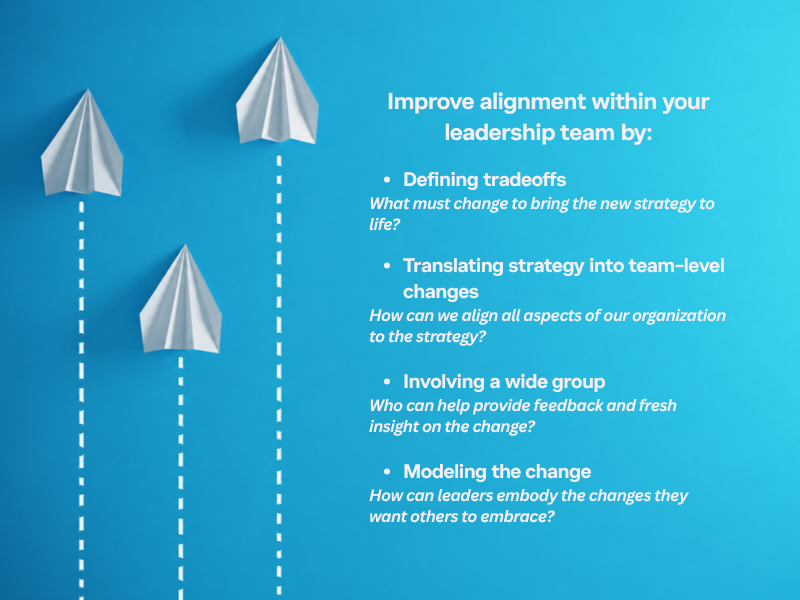
1. Define the Tradeoffs
Every strategy comes with implications. If leaders are not clear on what will change—or what will stop—then the organization will simply attempt to do more, rather than doing something different.
Alignment begins when tradeoffs are made explicit. For every new strategic priority, define the old priorities, habits or investments that must give way. This helps prevent the “smile-and-nod” response, where leaders agree in principle but keep operating as they always have.
2. Translate strategy into team-level changes
Big-picture agreement is not enough. Leaders need to ask: What does this strategy change in each function, team and workflow? Clarify new expectations, decision rights, success measures and cross-functional dependencies. When leaders connect strategy to daily work, teams are far less likely to drift back to old habits.
3. Broaden Ownership
Alignment breaks down when strategy is developed in a small circle and handed off to others for execution.
The leaders responsible for delivering the outcomes should be involved early, before decisions are finalized. They need to understand the rationale, contribute to shaping the path forward and see their role in making it successful. That involvement builds both clarity and commitment, which are essential for sustained execution.
4. Model What Matters
Employees look to leaders for signals about what really matters. If leaders continue old behaviors, mixed messages spread fast. Each leader should identify the specific behaviors they need to model, from how they communicate priorities to how they make decisions and allocate time. When the leadership team models the desired culture, the rest of the organization is more likely to follow.
Moving from Agreement to Alignment
Most organizations don’t struggle because they lack strategy. They struggle because their strategy doesn’t change how the organization operates.
The leadership teams that execute well recognize that alignment is not something you achieve in a meeting—it’s something you build into the system. They work through the tradeoffs, connect strategy to the realities of how work gets done and hold themselves accountable for reinforcing the change through their own behavior.
None of this is particularly easy, and it rarely feels as clean as agreement in a conference room. But that’s the point.
Alignment requires a level of discipline and honesty that agreement does not.
And for leadership teams, it’s one of the few capabilities that consistently separates strategy that sounds good from strategy that delivers results.