
Across the Fortune 500, something fundamental is shifting. It’s not strategy. It’s not talent. And it’s not even technology. It’s the organization itself.
Over the past 12–18 months, companies like Amazon, Meta, Shell, FedEx and Eli Lilly have made bold moves—AI investments, major restructuring, network consolidation and multi-billion-dollar acquisitions. On paper, these moves should unlock growth, efficiency and competitive advantage.
And yet, in conversation after conversation with executives, a different story emerges:
The strategy is sound, but the organization can’t quite execute it. That’s not a technology problem or a people problem. It’s an organization design problem.
The New Pattern: Strategy Is Moving Faster Than Structure
Consider just a few signals:
- Amazon is eliminating entire layers of management while shifting investment toward AI
- Meta is redesigning around smaller, AI-native teams and radically flattening its structure
- FedEx is consolidating Ground and Express into a unified operating network
- Shell is integrating a $16B+ acquisition to reshape its energy portfolio
- Eli Lilly is accelerating pipeline expansion through a wave of acquisitions and partnership
Each of these moves is rational, but they all create the same downstream effect. The way work gets done changes faster than the organization itself. That’s where friction shows up.
Where Organizations Break
In these moments of transformation, the breakdown rarely happens where executives expect it. It doesn’t show up in strategy decks, it shows up in the spaces between teams.
1. Decision-Making Slows Down—Even as Expectations Increase
Amazon is removing layers to increase speed, but many companies discover that fewer layers without clear decision rights creates confusion. Who owns the decision? Who has authority? Who is accountable?
Without clarity, speed doesn’t increase—it fragments.
2. Product, Platform and Customer Models Drift Apart
Often, growth creates complexity faster than structure can adapt. Product expands, platform capabilities grow and customer segments evolve, but the organization still reflects an earlier version of the business.
The result:
- Misaligned go-to-market motions
- Conflicting product priorities
- Slower customer response
3. Integration Happens on Paper—but Not in Reality
Shell’s acquisition of ARC Resources strengthens its portfolio. Eli Lilly’s deal activity expands its pipeline. M&A integrations have many benefits, but companies may find that they haven’t accounted for challenges like:
- No one redesigned how work flows across the combined organization.
- Legacy structures persist. Decision rights overlap. Interfaces become friction points.
- The assets are integrated, but the organization isn’t.
4. Cost-Cutting Without Redesign Creates Rework
In companies like FedEx, Tyson Foods and across the industrial sector, large-scale restructuring is underway. Facilities close, roles are cut and costs are reduced, but here’s the catch: most organizations cut cost but don’t redesign the work.
So, what happens?
- Duplication creeps back in
- Accountabilities remain unclear
- Efficiency gains erode over time
5. AI Doesn’t Just Change Work—It Changes the Organization
This is the newest and most underappreciated shift. At Meta and Intuit, AI isn’t just improving productivity—it is changing what roles exist, how teams operate and how decisions are made.
What used to require teams now requires individuals, and what used to require management layers now requires orchestration. Even still, most organizations are still structured around the pre-AI model of work. That misalignment is becoming the next major bottleneck.
The Real Issue: Organizations Are Still Designed for Yesterday
Across all of these examples, a clear pattern emerges. The organization is the last thing to change, but the first thing to break. Why? Because most companies treat organization design as:
- A restructuring exercise
- A reporting-line change
- A response to cost pressure
But what’s needed is a deliberate design of how work, decision-making and accountability should function in the future.
What High-Performing Organizations Do Differently
In our work at AlignOrg Solutions, we see a distinct pattern among companies that successfully navigate these transitions. They don’t just “reorg,” they redesign how the organization works.
That includes:
1. Clarifying Decision Rights
Not just who reports to whom—but who decides what and how quickly.
2. Aligning Structure to Value Creation
Organizing around:
- Products vs. platforms
- Customer journeys
- End-to-end processes
Not legacy functions.
3. Redesigning Interfaces (Not Just Boxes)
Most friction doesn’t happen inside teams, it happens between them. High-performing organizations intentionally design:
- Hand-offs
- Governance
- Cross-functional accountability
4. Matching the Org to the Work (Not the Past)
As AI, scale, or M&A change the nature of work, the organization must adapt accordingly. That means asking:
- What creates value now?
- What decisions matter most?
- Where does coordination need to happen?
5. Treating Organization Design as a Strategic Lever
Not a one-time event, but an ongoing capability. In today’s environment, strategy will continue to change. Organizations must be able to keep up.
The Opportunity Most Leaders Miss
Here’s the opportunity hiding in plain sight. Most companies are facing similar pressures:
- AI transformation
- Growth complexity
- Cost pressure
- Integration challenges
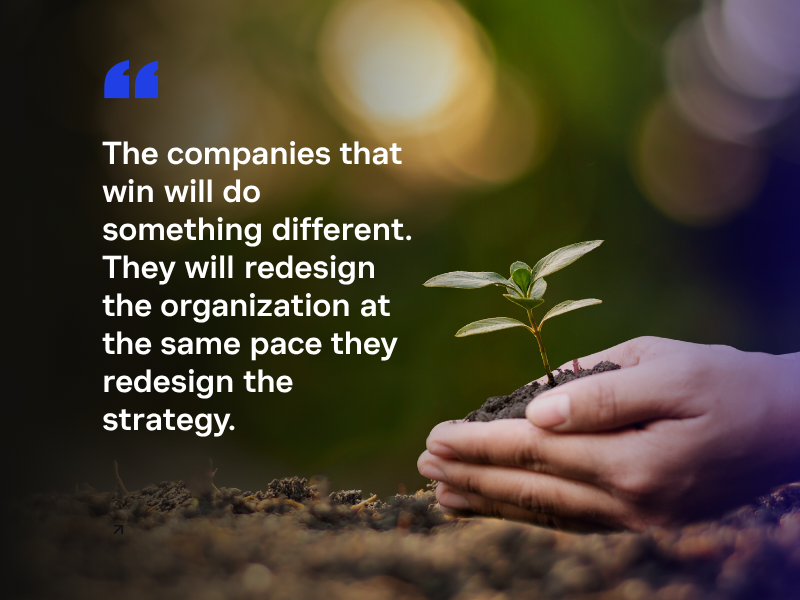
But very few are addressing the root cause. Instead, they are optimizing around the edges. The companies that win will do something different. They will redesign the organization at the same pace they redesign the strategy.
A Question Worth Asking
If your strategy is evolving—and it almost certainly is—is your organization designed for that future state, or is it still operating based on yesterday’s assumptions? The constraint is no longer insight or ambition, it’s execution. And execution lives—or dies—inside the organization.
If you’re seeing this tension in your business, I’d be interested in comparing notes.