
Artificial Intelligence has become one of the most discussed topics in business today. Every week seems to bring a new tool, new capability, or new prediction about how AI will transform the workplace.
Yet in conversations with leaders across industries, I continue to hear a similar question:
“What should we actually be doing with AI?”
It’s a fair question.
While the technology is advancing rapidly, many organizations are still working to determine where AI can create meaningful value—and how to implement it responsibly.
From my perspective as an organizational analytics leader, the most successful AI initiatives aren’t necessarily the most sophisticated. They’re the ones that solve real business problems, improve decision-making and create better outcomes for people.
The goal isn’t simply to adopt AI.
The goal is to make AI matter.
Start with the Problem, Not the Technology
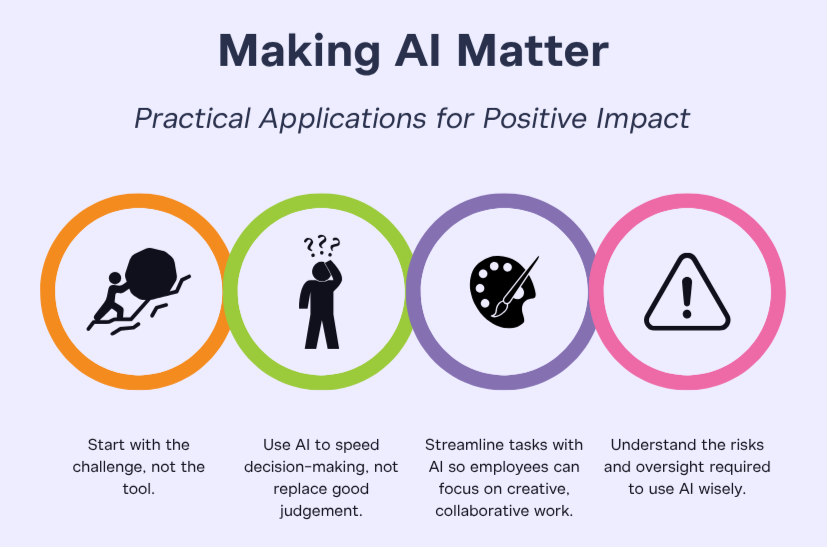
One of the biggest mistakes organizations make is starting with the tool instead of the challenge they’re trying to solve.
The organizations seeing the greatest success with AI are asking practical questions:
- How can we reduce manual work?
- How can we improve access to information?
- How can we help leaders make better decisions faster?
- How can we create a better employee experience?
- How can we free up time for more strategic work?
When AI is tied directly to a business problem, the value becomes much easier to identify, measure and scale.
This is particularly important because most organizations aren’t struggling with a lack of technology. They’re struggling with limited capacity, increasing complexity, competing priorities and growing demands on their workforce.
AI can help address those challenges—but only when applied intentionally.
AI and the Future of Organizational Decision-Making
Much of my career has focused on helping organizations understand how work gets done, how teams are structured and how talent can be aligned to business strategy.
This is an area where AI has enormous potential.
Leaders today are often making workforce decisions based on fragmented data spread across systems, functions and business units. AI can help synthesize information more quickly, identify patterns and surface insights that may otherwise take weeks to uncover.
For example, AI can support:
- Workforce planning and forecasting
- Organizational design analysis
- Skills and capability assessments
- Talent strategy development
- Scenario modeling and workforce optimization
- Knowledge management and information retrieval
Importantly, AI does not replace leadership judgment.
It enhances it.
The most effective organizations will use AI to improve the quality and speed of decision-making while continuing to rely on human expertise for context, interpretation and action.
Creating Better Employee Experiences
One of the most practical applications of AI is improving how employees interact with work.
Many employees spend a surprising amount of time searching for information, navigating systems, responding to repetitive requests and completing administrative tasks.
AI can help streamline these activities by:
- Providing self-service support
- Summarizing complex information
- Automating routine processes
- Personalizing learning and development experiences
- Supporting onboarding and knowledge transfer
The result isn’t simply increased efficiency. It’s creating space for employees to focus on work that requires creativity, collaboration, critical thinking and relationship-building—the things humans do best.
AI for Good: Expanding the Conversation
While much of the conversation around AI focuses on productivity and business performance, I’m equally interested in how AI can be used to create positive social impact.
That’s one of the reasons I’m excited to be serving as a Pod Mentor for the AI for Good ITWomen Challenge.
Programs like this bring together emerging leaders, innovators and problem-solvers to explore how AI can address meaningful challenges in our communities and workplaces.
What I find particularly encouraging is the emphasis on diverse perspectives. The future of AI should not be designed by a small group of people with similar experiences. It should be shaped by individuals with different backgrounds, viewpoints and lived experiences who can identify opportunities, risks and solutions that others may miss.
If AI is going to help solve some of society’s most complex challenges, diversity of thought will be one of its greatest strengths.
Responsible AI Is Good Business
As organizations expand their use of AI, governance and accountability become increasingly important.
Questions around privacy, bias, transparency and trust cannot be treated as afterthoughts.
Leaders should understand:
- How AI-generated outputs are created
- What data is being used
- Where risks may exist
- What level of human oversight is required
- How decisions are communicated and validated
In many ways, responsible AI adoption mirrors successful organizational transformation efforts.
Technology implementation alone does not create results.
Clear governance, stakeholder engagement, change management and leadership alignment are what ultimately drive successful outcomes.
The same principle applies to AI.
While many organizations approach AI as a technology initiative, we increasingly see it as an organization design challenge. Introducing AI changes how work gets done, but it also affects decision rights, accountability, workforce capabilities, performance measures, and culture. At AlignOrg, we use the Cube Model to help leaders understand these interdependencies and align the broader operating model around how AI changes work. Sustainable value comes not from implementing AI tools in isolation, but from ensuring the entire system is designed to support the desired outcomes.
Looking Ahead
I believe we’re still in the early stages of understanding what AI can do for organizations and society.
The opportunities are significant, but so is the responsibility.
The organizations that will realize the greatest value won’t necessarily be those with the largest AI investments. They’ll be the ones that remain focused on solving meaningful problems, empowering their people and applying technology thoughtfully.
For leaders, the conversation should move beyond “How do we use AI?”
A better question is:
“How do we use AI to make better decisions, create better experiences and deliver greater impact?”
When we approach AI through that lens, we move beyond experimentation and toward transformation.
And that’s where AI starts to matter.