
Have you ever been in a meeting where smart, capable people are discussing options, debating tradeoffs, or moving through a check-the-box activity, and the conversation keeps drifting in multiple directions? Finally, someone asks, “What are we solving for?” I have seen this repeatedly across new products, internal practices, technology implementations, operating model shifts and organizational redesigns. And, I have experienced it personally.
Earlier in my career, I led the implementation of a new leadership model and meaningful changes to our performance management practices. We had done thoughtful internal and external research. We had a compelling “why.” We had some visible support. Then, in one of my first meetings, an HR leader asked, “Why do we need this right now?” My immediate thought was, “Oh dear—if we are not aligned in our own function, how are we ever going to bring 17,000 people along?” We forged ahead, but it often felt like pushing a rock up a hill.
Organizational design work is especially vulnerable to this kind of ambiguity because structure can feel personal and changing an organizational system is complex. It affects roles, reporting lines, decision rights, status, workload, career paths, customer handoffs, metrics, and how work actually gets done. A redesign may look logical on paper, but if leaders have not aligned on the problem, the boundaries, the criteria for success and the people who need to be engaged, the work can quickly become political, slow, or over-engineered.
The good news: successful organization design does not require leaders to have every answer at the start. It does require them to create enough clarity to make good choices as the work unfolds. Three practical tools help: a project charter, design criteria and a stakeholder engagement plan.
1. Start With a Charter: Name the Work Before You Start Doing the Work
A strong organization design charter is not a bureaucratic formality. It is the leadership team’s shared contract for the work. It answers the questions that, if left unclear, will show up later as churn:
- What problem are we solving? And what outcomes matter most?
- Why now? What constraints are real?
- What is in and out of scope?
- Who decides what?
Executive leaders bring the enterprise vision, mission, strategy and business case. As they enroll a team to lead the redesign, the charter helps translate that strategic intent into practical guardrails so the team can move with confidence—not wait for direction at every turn.
At minimum, an organization design charter should include:
- The business problem or opportunity
- Strategic objectives
- Expected deliverables
- Scope and exclusions
- Timeline
- Resources
- Roles and governance
- Decision rights
- Key risks
- Assumptions
- Success measures
The discipline is not in making the charter long. The discipline is in making it useful. A practical charter should be clear enough that a team member can use it to make decisions, a sponsor can use it to test whether the work is drifting, and a stakeholder can use it to understand why the work matters.
A simple test: if the project team cannot explain the charter in two minutes, it is probably not sharp enough yet. Before moving into interviews, structure options or implementation planning, take the time to align on the charter. It will save weeks of rework later.
2. Define Design Criteria: Decide What “Good” Looks Like Before Debating Boxes and Lines
Design criteria are the bridge between strategy and structure. They answer the question: “A new design will be successful if…” Without criteria, leaders often evaluate design options based on personal preference, functional advocacy, legacy norms, or who makes the strongest argument in the room. With criteria, the conversation becomes more objective and grounded in the outcomes the organization is trying to create.
Good design criteria are specific, strategic and usable. They should reflect who the organization is built to serve, what capabilities are required to deliver value and what tradeoffs leaders are willing to make. For example, criteria might include faster customer decision-making, clearer enterprise accountability, stronger local market responsiveness, or better end-to-end process ownership.
The most useful criteria are written in plain language and used actively. They are not a slide that appears once and disappears. They become the mirror leaders hold up to each design option:
- Does this option improve the capabilities we said matter most?
- Does it make decision-making simpler or more complex?
- Does it help us serve the customer or audience better?
- Does it create new risks we are not prepared to manage?
One practical approach is to limit the list to five to seven design criteria and pressure-test them with the leadership team before generating design options. If everything is equally important, nothing is. Senior leaders should expect healthy debate here. The discussion about criteria is often where hidden assumptions surface: Do we value speed over consistency? Enterprise leverage over local autonomy? Specialization over simplicity? These are exactly the conversations leaders need to have before the organization starts moving.
3. Make Stakeholder Engagement Everyone’s Job
Stakeholder engagement is often treated as the job of change management. Change professionals may own the mechanics—messages, engagement plans, feedback loops, leader toolkits—but the responsibility cannot sit with them alone. In organization design, stakeholder engagement is leadership work. People need to understand the case for change, see how decisions are being made, trust that their input has been considered and know what will happen next.
A practical stakeholder plan begins with a few simple questions:
- Who is impacted?
- Who has influence?
- Who has information the design team needs?
- Who will have to sponsor, implement, or live with the new design?
- Who is likely to be concerned, skeptical, or overloaded?
Then, for each group, clarify the purpose of engagement. Are you informing, listening, co-creating, validating, preparing, or mobilizing?
Not every stakeholder gets the same level of involvement and that is okay. The key is to be intentional and transparent. A senior executive team may set direction and make enterprise tradeoffs. Senior leaders may shape options, identify operational implications and prepare their teams. Managers may help translate what the change means for work, roles and priorities. Employees may provide insight into customer pain points, process friction and unintended consequences. The mechanics differ, but the principle is the same: engage people in ways that match their role in the change.
Leaders should also plan for listening, not just telling. In a redesign, stakeholders may not agree with every decision, but they are more likely to support the direction when they understand the rationale and see evidence that real input shaped the work. Build feedback loops into the project rhythm: stakeholder interviews, design workshops, pulse checks, manager forums, office hours, or targeted reviews. Then close the loop by saying what was heard, what changed and what could not change—and why.
Bringing the Three Tools Together
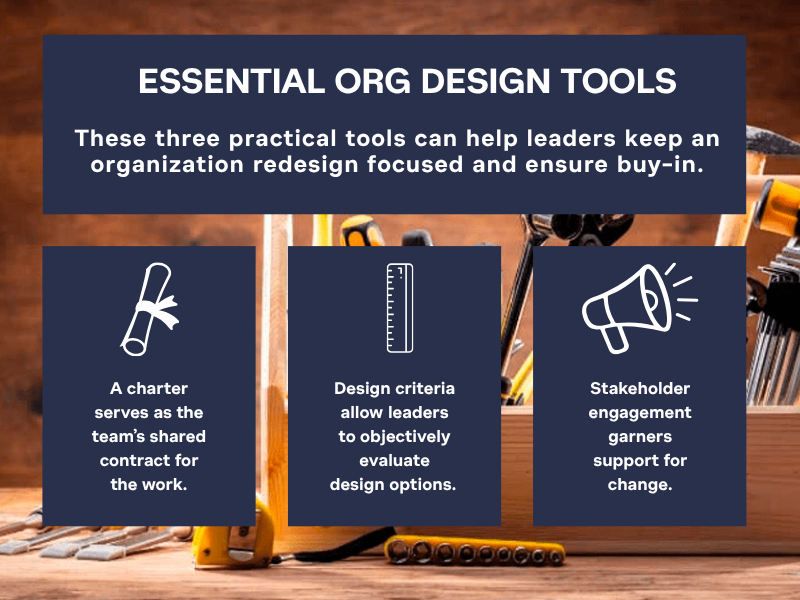
A tool is a means to an end. Used well, they build trust and smooth the path to a successful design. The charter, design criteria and stakeholder engagement plan are most powerful when used together. The charter creates alignment on the work. The design criteria guide choices. The stakeholder plan builds understanding, input and ownership. Together, they help leaders avoid three common traps: starting too fast without alignment, designing around preferences instead of strategy and work and communicating too late after the major decisions are already made.
For senior leaders, the practical challenge is not to over-process the work. It is to create enough structure to enable speed, quality and trust. Before launching your next organization design effort, pause and ask: Do we have a charter clear enough to guide decisions? Do we have design criteria strong enough to evaluate options? Do we have a stakeholder plan thoughtful enough to bring the right people along at the right moments?
Organization design is ultimately about enabling strategy through the systemic alignment of people and work. A thoughtful structure matters, but the process leaders use to get there matters just as much. Start with clarity. Make the criteria visible. Engage stakeholders with intention. Those three disciplines will not eliminate every hard decision, but they will make the work more focused, practical and much more likely to stick.