
Redesigns are one of the most common—and most misunderstood—tools leaders use to drive change. When they fail, the postmortem is familiar:
“The structure didn’t work.”
“The roles weren’t right.”
“We needed a different model.”
But after decades of working with leadership teams across industries, we’ve come to learn an uncomfortable truth: Redesigns don’t fail because leaders choose the wrong structure. They fail because leaders never align on what needs to change. In short, structure becomes the scapegoat for a much deeper problem.
The False Comfort of Structure Changes
A redesign feels decisive. Boxes move. Reporting lines shift. New titles appear. From the outside, it looks like progress. But structure is only a container, and it does not create clarity on its own. When leadership teams jump straight to org charts, they often skip the challenging work of answering questions like these:
- What decisions must change?
- What behaviors must stop?
- What work really matters now?
- What trade-offs are we willing to make?
Without clarity on those questions, a new structure simply hardens old confusion into a new shape.
The Alignment Gap Leaders Don’t See
Most leadership teams believe they are aligned. They put in the hours to solidify strategy and approve the redesign, but alignment isn’t the same thing as agreement. Alignment is a shared understanding that holds up under pressure. We routinely see leadership teams who:
- Use the same words but mean different things
- Agree on priorities in theory, then reinforce different ones in practice
- Believe someone else is responsible for making the hard calls
The result? Each leader interprets the redesign through their own lens, leads their function accordingly and the end results look vastly different across the organization. Confused and exhausted by changing messages and shifting priorities, employees stop trusting what they’re told and start optimizing for survival. At that point, even a well-designed structure can’t save execution.
What Actually Needs to Change (But Rarely Gets Named)
Before structure changes, leaders must align on a small set of non-negotiables. In failing redesigns, these are either vague or completely unspoken.
Here are the most common gaps we see:
1. Decisions
Which decisions must move faster? Which must move closer to the customer? Which should no longer require senior approval? If leaders can’t name the decisions the redesign is meant to improve, the structure will not deliver the intended outcomes.
2. Work
What work matters now? Redesigns often add new priorities without subtracting old ones. Teams become overloaded, they lose focus and execution slows.
3. Accountability
Who owns outcomes versus inputs? Who integrates across silos? Who makes the final call when priorities conflict? Ambiguity creates frustration and erodes efficiency.
4. Behavior
What leadership behaviors must change for this redesign to succeed? If leaders continue to operate the same way—escalating the same issues, protecting the same turf, avoiding the same tensions—the structure will quietly collapse under old habits.
The Leadership Work That Makes Redesigns Work
Successful redesigns follow a very different sequence. Instead of starting with boxes and lines, aligned leadership teams start by answering a few deceptively simple questions:
- What must be different six months from now for this redesign to be worth it?
- What decisions are we struggling with today and how can a redesign help?
- What are we explicitly choosing not to prioritize?
- What behaviors will we reinforce—even when it’s uncomfortable?
Only after alignment on those answers does structure become a powerful enabler rather than a distraction.
Alignment in Action
Redesigns reveal what leadership teams are willing—and unwilling—to confront. They expose unresolved tensions, unclear priorities and avoidance of hard trade-offs
When leaders use structure to bypass alignment, the organization pays the price. But when leaders align first, structure becomes a force multiplier and work proceeds with confidence.
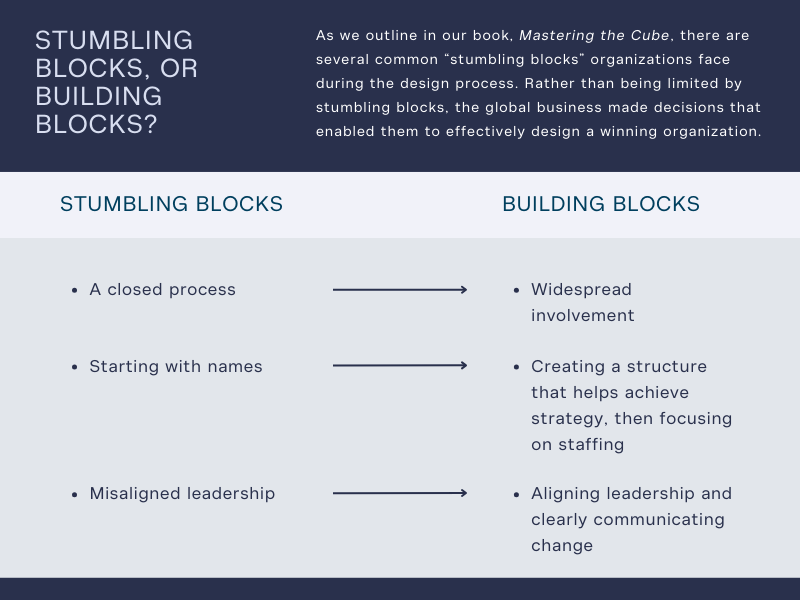
I saw the power of alignment in action when I worked with a global organization that was undergoing a major redesign. Here’s what they did right:
- They involved a broad set of key leaders and internal experts in decisions from the outset, assuring they had buy-in.
- Rather than build a structure around key employees, they created a structure that would help them achieve their strategy and staffed it accordingly.
- They were willing to make tough decisions about which employees were capable of taking on new challenges, then unified on those decisions and shared a single message with their teams.
- They were clear about what the redesign would look like for every employee within the organization, including how their roles and priorities would change.
The result of this thoughtful, alignment-first approach to redesign positioned the organization for long-term success. Employee turnover rates dropped, and internal surveys were overwhelmingly positive.
Before your next redesign, don’t ask, “Is this the right structure?” Instead, ask, “Are we truly aligned on what must change—and are we prepared to lead differently once it does?”
No structure can compensate for misaligned leadership, and no redesign can succeed without it.