
A Familiar Story
On a Monday morning, leaders announced a new organizational design intended to simplify decision-making and accelerate execution. By Wednesday, inboxes were full of questions:
- How do the new processes work?
- Which metric matters most?
- How do the new teams interface with other departments?
Six months later, performance was mixed, frustration was high and the verdict was swift—the structure isn’t working. A redesign began almost immediately. Twelve months after the original launch, employees found themselves in their third version of the “future-state” organization. Trust eroded. High performers quietly updated their résumés. Leaders felt stuck between the pressure to act and the fatigue of constant change. The real issue, however, was never just the structure—it was the absence of disciplined organizational design (OD) governance.
Why Governance Matters
In transformation-heavy organizations, OD is often treated as a series of disconnected events rather than a system of interdependent choices. Structures are implemented without stability, employees are impacted by multiple initiatives at once and performance issues are attributed to the org chart instead of gaps in clarity, metrics or ways of working.
Effective OD governance breaks this cycle by:
- Preventing redesign churn
- Distinguishing transition pain from design flaws
- Ensuring deliberate, evidence-based change
Below are eight governance principles that consistently unlock sustained value.
Eight Principles for Effective OD Governance
1. Allow time to evaluate change
In one organization, a new commercial model was questioned within months due to early performance noise and resistance. Leaders reacted quickly, undoing parts of the design before teams had time to adapt. The result was confusion, credibility loss and a second redesign driven by the same symptoms.
Stability windows ensure leaders evaluate designs based on evidence—not early discomfort.
2. Avoid change overload
A population of data specialists was simultaneously affected by a functional redesign, a digital transformation and a sales reorganization. Each change was logical on its own; together they created overload, unclear priorities and attrition risk.
Cumulative impact governance ensures transformation avoids repeatedly disrupting the same employees.
3. Coordinate redesign initiatives
Two parallel initiatives independently redesigned interfaces with the same teams, creating overlapping forums and conflicting decision rights. Without cross-initiative visibility, well-intended efforts collided.
Horizontal governance surfaces intersections early, when they are still easy to resolve.
4. Define success
After a reorganization, leaders complained that decision-making felt slower. In reality, accountability had shifted and leaders were still adjusting. Without clear criteria, discomfort was mistaken for failure.
Clear goalposts prevent leaders from redesigning in response to noise rather than evidence.
5. Ensure leaders “walk the talk”
In one transformation, leaders approved a new design but publicly questioned it when implementation got hard. Employees took the signal seriously. Confidence dropped, resistance rose and the design never had a fair chance.
Hold leaders accountable for providing stability and reinforcement through the transition.
6. Master the cube
An organization repeatedly changed reporting lines to fix persistant performance issues. Only later did leaders realize the real problems were unclear roles, misaligned metrics and broken handoffs.
A formal completeness gate ensures all facets of your organization—work, structure, people and rewards, continuous alignment, metrics and culture—are addressed before structure alone is blamed.
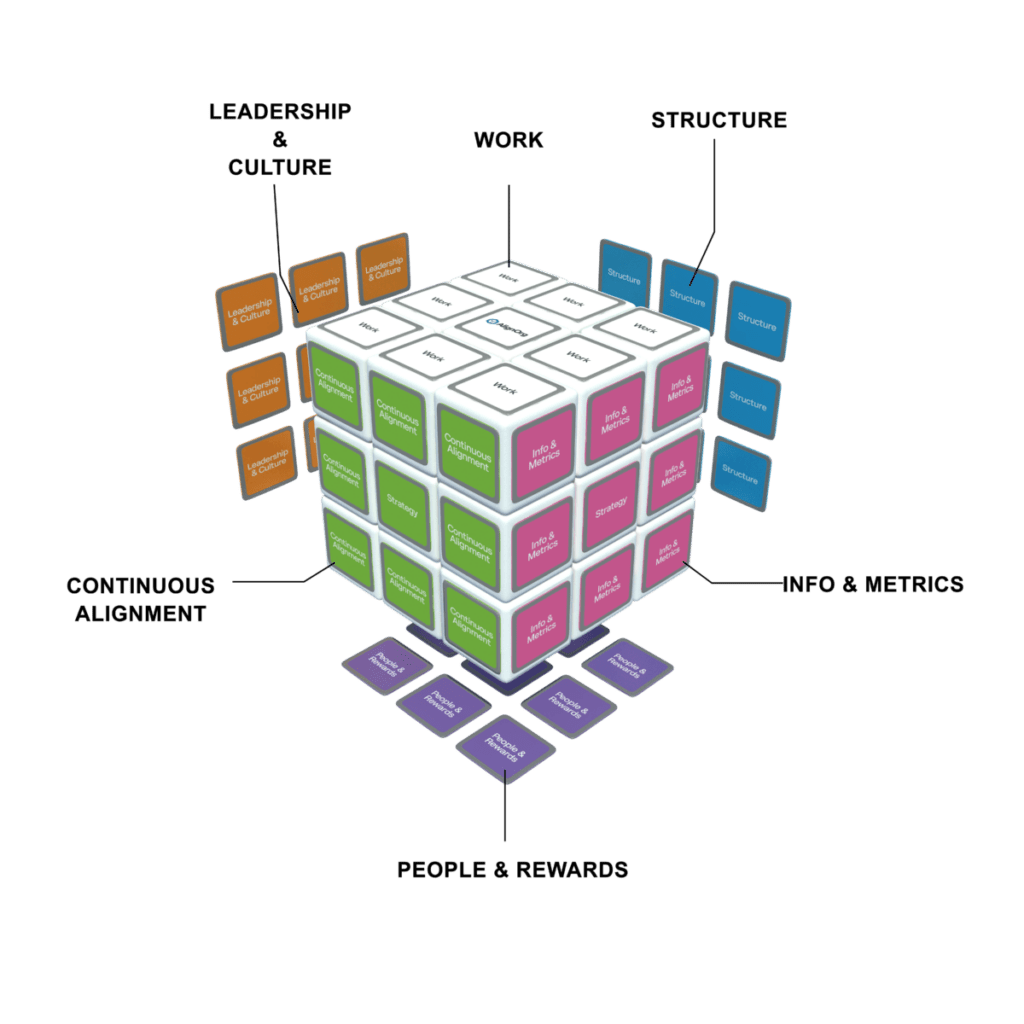
At AlignOrg Solutions, we like to visualize organizations as a six-sided Rubik’s Cube. All “sides,” or aspects of an organization, must be aligned with strategy for redesign success.
7. Use an alignment index
In contrast to intuition-driven redesigns, organizations that use an Organizational Alignment Index (OAI) establish a baseline before change and can reassess once the design stabilizes.
Data allows leaders to see where alignment has improved and where gaps remain—enabling targeted fixes instead of wholesale restructuring.
8. Welcome collaboration
In many organizations, OD work is treated like a confidential exercise—limited to a small group of leaders or consultants who design the future state behind closed doors. While often done with good intent, this “secret society” approach frequently backfires.
Employees are more likely to embrace what they help create.
Case Study: The Danger of Secret Societies
In one organization, only a handful of senior leaders were involved in designing a major restructuring. When the new model was announced:
- Employees were shocked by role definitions that didn’t reflect how work actually happened.
- Critical interdependencies were missed.
- Informal decision paths were broken.
- Leaders spent months explaining choices that could have been improved—or avoided—had more voices been included earlier.
- Resistance hardened not because people disliked change, but because they felt excluded from shaping it.
A collaborative OD approach expands the tent deliberately. It engages a broader set of stakeholders to surface real work flows, stress-test design choices and build shared understanding before decisions are finalized. This does not mean consensus-driven design—but it does mean transparency, participation and informed input. The payoff is meaningful buy-in, stronger solutions, smoother implementation and fewer surprises after launch. Collaboration becomes a governance lever that improves both the quality of the design and the sustainability of the change.
What Good Looks Like
Organizations that apply these principles govern OD as a system, not a reaction. Designs are given time to work. Employees experience fewer overlapping disruptions. When performance issues arise, leaders diagnose alignment and completeness before reaching for structural change. Over time, redesign cycles slow, trust increases and execution improves.
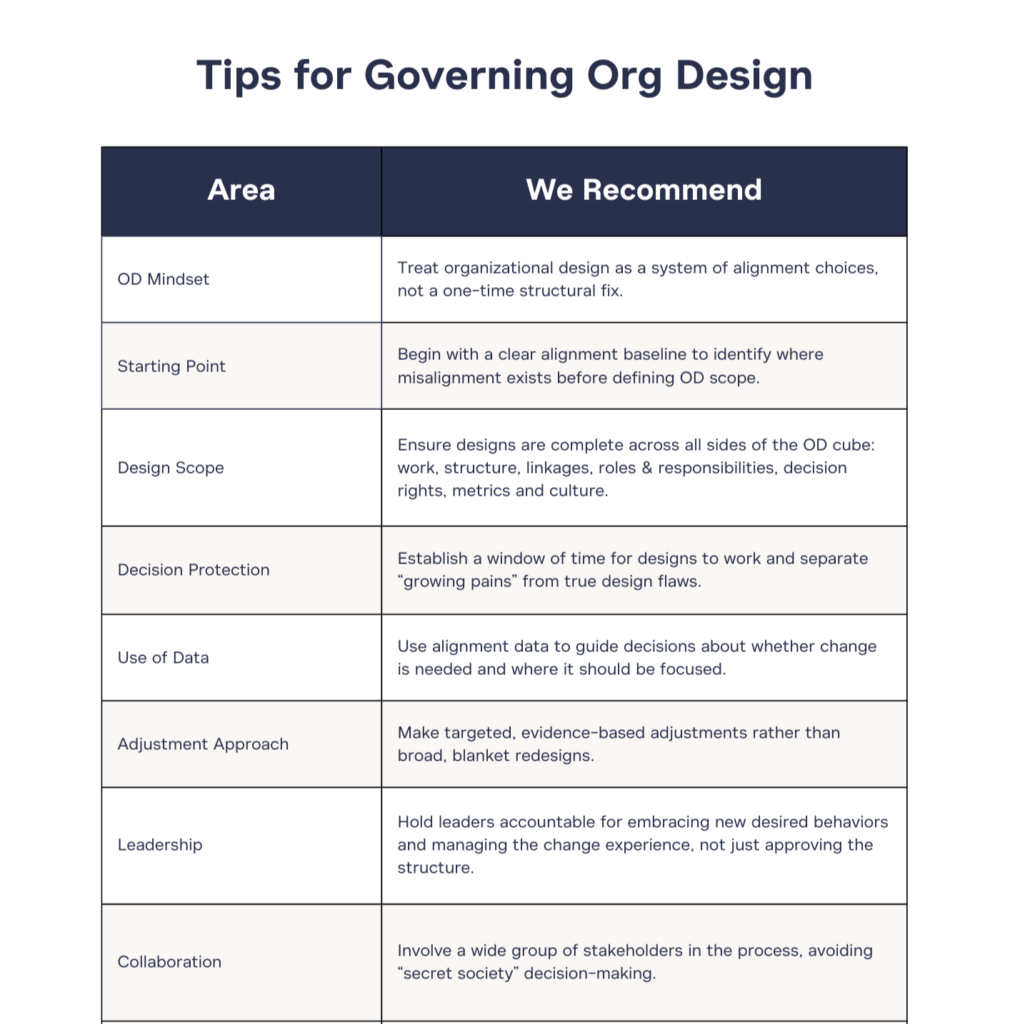
Use this checklist before approving, undoing, or redesigning an OD decision:
OD Governance Checklist
Alignment & Evidence
- Do we have a current alignment baseline (e.g., OAI) to justify this OD effort?
- Are we clear on which alignment gaps we are trying to address?
Design Completeness
- Are roles and responsibilities clearly defined and understood?
- Are decision rights explicit where work crosses teams or functions?
- Are metrics aligned to reinforce the desired behaviors and outcomes?
- Are key handoffs, forums and linkages clearly designed?
- Are expectations and capability implications clear for impacted roles?
Stability & Timing
- Has the design had sufficient time to stabilize before being reconsidered?
- Are current issues transition-related or evidence of sustained misalignment?
Cumulative Impact
- Who is impacted by this change and how many other initiatives affect them?
- Have sequencing and pacing tradeoffs been explicitly considered?
Collaboration & Leadership
- Have the right stakeholders been involved to reflect how work actually gets done?
- Are leaders aligned and visibly accountable for sponsoring the change?
If several boxes cannot be checked, the issue may not require a structural redesign. Addressing clarity, governance, or alignment gaps first often resolves the problem without creating additional disruption.
Our Recommendations
The greatest risk leaders face is not choosing the wrong structure, but treating organization design as a series of isolated structural fixes rather than a system of alignment choices.
This approach changes outcomes. Employees experience fewer overlapping disruptions, clearer expectations and greater confidence that today’s design will not be undone tomorrow. Leaders gain a fact base to guide decisions, resist premature reversals and focus energy where it will matter most. The organization moves faster—not because it changes more often, but because it stops starting over.
Let’s revisit the opening story through this lens. The initial design would have been informed by alignment data, completed across all dimensions and protected long enough to work. Performance concerns would have led to precise course corrections—not another reorganization. Trust would have grown instead of eroded. These are the outcomes we see when OD is governed deliberately—using stability, evidence, completeness, collaboration and alignment as the foundation for change.