
High Performance Lessons from Team USA
Every four years, the Olympic Games slow the world down. We watch athletes step into moments where preparation meets possibility, where years of commitment are brought to life in a matter of minutes. The stage is global, the pressure is real and the opportunity to perform at your best has finally arrived.
For executives leading organizations through transformation, this moment feels familiar. The context is different, but the essence is the same. Strategies move from paper to practice. New ways of working take shape. Leaders look for a competitive advantage that is not theoretical, but real and scalable.
As a senior consultant with AlignOrg Solutions and a sport psychologist working with elite figure skaters, I see the same dynamic play out in both worlds. In moments of pressure and uncertainty, performance depends less on individual talent and more on whether teams are aligned to think clearly, coordinate effectively and make sound decisions together.
Excellence is never accidental. It is designed.
Pressure Exposes Design
Ilia Malinin entered the Olympics as the reigning world champion and one of the most technically advanced figure skaters in history. Known as the Quad God, he became the first skater to land a quadruple axel in competition and regularly attempts more quadruple jumps than anyone before him. He arrived at the Olympics as the clear favorite for gold.
In the individual competition, the result did not match the expectation. After a strong short program, his free skate included multiple errors and falls, and he finished off the podium. For an athlete whose identity entering the Olympics was dominance, the outcome was both significant and devastating.
What he later described was revealing. In the moment, time felt like it sped up. The program moved faster than his ability to recalibrate. That is not a talent issue. That is a regulation issue. Under extreme pressure, execution becomes less about capability and more about the system supporting it. In sport, reset routines, pacing discipline and mental rehearsal are built to prevent one error from cascading into several.
The organizational parallel is direct. When a transformation begins to wobble, it rarely collapses because the strategy was unintelligent. It falters because decision rights are unclear, tradeoffs are made too late, or teams lack built in reset mechanisms. When pressure increases, organizations without performance clarity experience execution drift. Like an athlete without a reset routine, one misstep compounds into many. Organizational design must anticipate pressure and engineer stability before performance is tested publicly.
Response Reflects System Maturity
After the competition, Malinin did not retreat. He openly acknowledged how overwhelming the moment felt. In the exhibition gala, he returned with an emotional performance centered on the psychological toll of elite competition and the importance of mental health. He addressed the pressure directly rather than pretending it did not exist.
That response matters. In high performance systems, how you respond to a breakdown determines future stability. Avoidance increases fragility. Ownership builds resilience. In sport, post-performance analysis is disciplined. Coaches review footage, isolate variables, adjust training plans and reinforce mental routines. The system adapts.
In organizations, setbacks reveal maturity. Do leaders create psychological safety so teams can speak honestly about what failed? Are after action reviews structured around process rather than blame. Is accountability clear enough that learning leads to redesign. Organizational design is not static. It must evolve in response to stress signals. Leaders who acknowledge pressure, regulate first and adjust structure accordingly build systems that learn, adapt and perform more consistently over time.
Alignment Is the Competitive Advantage
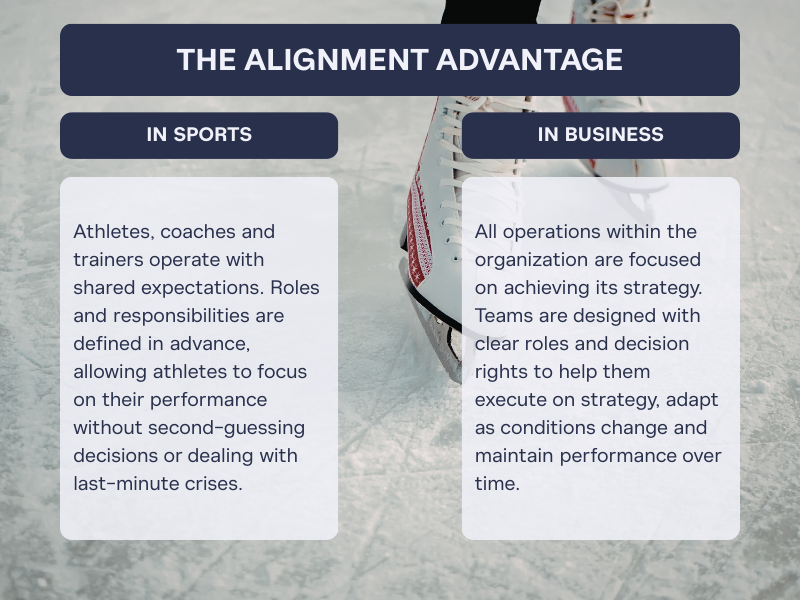
Across elite sport and organizational transformation, the moments that matter most are defined by pressure and uncertainty. In those moments, performance depends less on individual talent and more on whether teams are designed to think clearly, regulate effectively, coordinate seamlessly and make sound decisions together.
Effective teams are not defined by effort or outcomes alone. They are defined by how well their system holds under pressure. When roles, decision authority and feedback loops are clear, teams can slow the moment down instead of being overwhelmed by it. Under stress, alignment and built in reset mechanisms prevent small execution errors from cascading into larger breakdowns.
That same emphasis on performing in demanding environments is reflected in my book Your Competitive Advantage: An Athlete’s Guide to Getting Hired After Sport. In both sport and business, performance improves when individuals understand their strengths and how those strengths contribute within a well-designed team.
At AlignOrg Solutions, organizational design makes that alignment tangible. The AOS model connects work, structure, metrics, people practices and culture so teams execute strategy together rather than in parallel. It helps organizations adapt intentionally as conditions change and build resilience into the system instead of relying on individual heroics.
That is the real competitive advantage.
For leaders looking to build this capability intentionally, AlignOrg’s High-Performing Teams programming helps teams strengthen decision clarity, coordination and accountability under pressure. It translates strategy into disciplined day-to-day team effectiveness, where performance is sustained, not assumed.