This is part 2 in a series on the maximizing the potential of Alignment Leadership® Find part 1 here and watch for part 3 coming next week.
Every organization is built on a series of choices. Some are big and visible—like entering a new market or launching a new product. Others are subtle—like how teams make decisions, what leaders reward or how work flows across functions. But together, these choices shape something far more powerful than any single decision: capabilities.
Capabilities are not abstract ideas. They are the real, tangible outcomes of how an organization aligns its systems—work, structure and governance, metrics, people and rewards and leadership and culture. As my first Alignment Leadership blog noted, “every choice a leader makes…creates or reshapes capabilities.”
When leaders understand this, they stop treating decisions as isolated events. They start seeing them as part of a connected system—one where every choice creates a ripple and every trade‑off needs to be understood, articulated and aligned.
This is the heart of Alignment Leadership.
Capabilities: The Outcome of Connected Choices
A capability is the organization’s ability to consistently deliver something that matters—customer intimacy, operational excellence, innovation, speed, reliability or any other strategic requirement. But capabilities don’t appear because a leader declares them. They emerge when the choices across the AOS Cube reinforce one another.
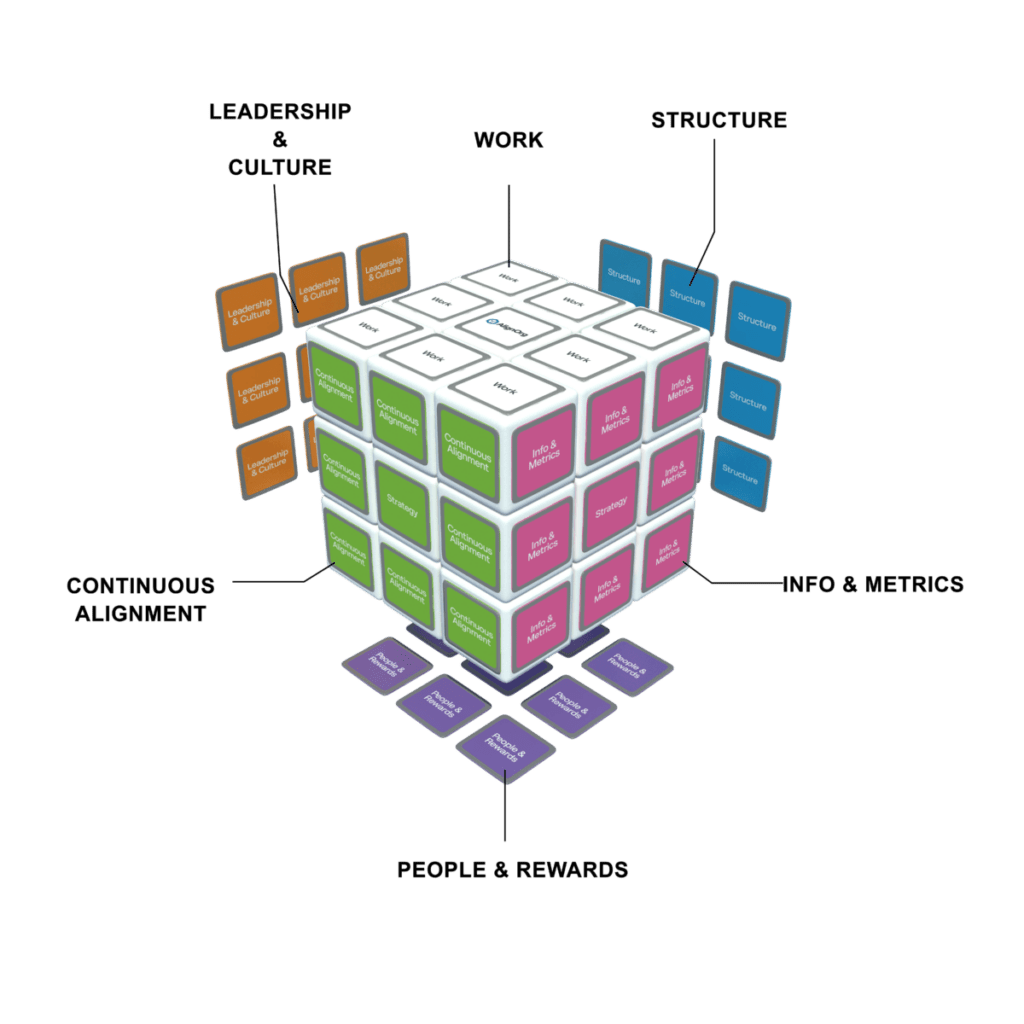
Chapter 5 of Mastering the Cube emphasizes this point: capabilities are “the product of aligned systems,” not the product of any single system acting alone. When leaders make choices in one area without reviewing the others, they unintentionally weaken the very capabilities they’re trying to build.
Great leaders understand that:
- Work defines what must be done
- Structure and governance define who makes decisions
- Metrics define what matters
- People and rewards define what gets reinforced
- Leadership and culture define how people behave
When these choices line up, capabilities strengthen. When they don’t, even the best strategy struggles to take hold.
Choices: The Building Blocks of Capability
Every leader makes choices. But alignment leaders make choices clear.
They don’t assume their teams understand the implications of a new priority or a shift in direction. They take the time to articulate the choices behind the strategy—what the organization is choosing to do, choosing not to do and choosing to do differently.
This clarity matters because choices cascade. A decision to prioritize customer experience, for example, isn’t just a marketing choice. It affects:
- How frontline work is designed
- How teams collaborate across functions
- What metrics matter most
- What skills are needed
- What leaders’ model and reward
When leaders make these connections explicit, teams can align their own decisions more effectively. When leaders don’t, teams fill in the gaps with their own assumptions—and misalignment grows.
Trade‑offs: The Leadership Discipline That Separates Good from Great
Trade‑offs are where Alignment Leadership becomes real.
Every strategic choice creates tension. If an organization chooses speed, it may sacrifice some precision. If it chooses customization, it may sacrifice some efficiency. If it chooses innovation, it may sacrifice predictability.
Great leaders don’t hide these trade‑offs. They name them, explain them and help teams navigate them.
This is one of the most important leadership behaviors in alignment work. When trade‑offs are visible, teams can make better decisions. When trade‑offs are hidden, teams unintentionally work against one another.
In Part 1, we learn, “The most effective leaders don’t just make decisions—they make aligned decisions.”
Aligned decisions require visible trade‑offs.
Case Study 1: When Trade‑offs Become a Strategic Advantage
A Fortune 100 logistics company wanted to build a capability around rapid fulfillment. The strategy required speed, but the existing culture prized precision above all else. Leaders recognized the tension early and made the trade‑off explicit:
“We are choosing speed. That means we will accept some controlled variability. Here’s where precision still matters—and here’s where speed must win.”
They then aligned the systems:
- Work: streamlined handoffs
- Structure: empowered local decision‑making
- Metrics: prioritized cycle time over perfect accuracy
- People and rewards: recognized teams that solved problems quickly
- Leadership and culture: modeled fast, informed decision‑making
Because the trade‑off was clear, teams didn’t fight the shift—they embraced it. The capability took hold quickly because everyone understood the choices behind it.
Case Study 2: When Hidden Trade‑offs Create Organizational Drag
A global healthcare company launched a new innovation initiative. Leaders talked about creativity, experimentation and bold thinking. But they didn’t address a critical trade‑off: innovation requires risk tolerance and the organization’s culture was deeply risk‑averse.
Teams heard the message “innovate,” but the metrics still rewarded predictability. Leaders encouraged experimentation, but performance reviews penalized failure. The systems were misaligned and the capability never materialized.
Only after leaders named the trade‑off—“We are choosing innovation and that means accepting some failure”—did the organization begin to shift. They adjusted metrics, changed incentives and modeled the behaviors they wanted to see.
The capability didn’t fail because the strategy was wrong. It struggled because the trade‑offs were invisible.
Case Study 3: When Leaders Help Teams See Their Own Choices
A Fortune 500 industrial company was trying to build a capability around customer intimacy. Leaders believed they had communicated the strategy clearly, but frontline teams were still making choices that reinforced internal efficiency over customer needs.
Instead of pushing harder, the senior leader gathered teams and asked a simple question:
“What choices are you making today that support customer intimacy? What choices are you making that work against it?”
The conversation surfaced dozens of hidden decisions—legacy processes, outdated metrics and cultural norms that no longer fit. The leader didn’t dictate solutions. He helped teams see their own choices and understand the trade‑offs.
Once the choices were visible, alignment became possible. Teams redesigned workflows, updated metrics and shifted behaviors. The capability strengthened because people understood how their daily decisions contributed to it.
Alignment Leadership: A Practical, Human Discipline
Alignment Leadership isn’t abstract. It’s the practical, everyday work of helping people understand:
- What capability the organization is trying to build
- What choices support that capability
- What trade‑offs those choices require
- How their own decisions fit into the larger system
This is straightforward, pragmatic leadership—clear, intentional and grounded in real‑world results. It’s also deeply empathetic. Leaders who make choices and trade‑offs visible reduce confusion and help people navigate change with confidence. And it’s collaborative. Alignment work is not done to people; it’s done with them.
When leaders embrace this discipline, they create organizations where decisions reinforce one another, capabilities strengthen and strategy becomes something people can actually deliver.
That is the work of Alignment Leadership.
Check back for part 3 in the series next week.