
Podcasts are my go-to for passing the time on long commutes, flights and doing boring housework. One of my favorites is Hidden Brain, hosted by Shankar Vedantam. Hidden Brain explores the unconscious patterns that drive human behavior and the questions that lie at the heart of our complex and changing world. Our daily lives are filled with routines and habits that help us conserve energy and improve efficiency. The downside is that these routines can sometimes limit our ability to thrive as our personal and professional environments evolve. So, I appreciate anything that helps move my mindset forward.
Organizations can fall into similar patterns. They adopt routines, processes and behaviors that were once helpful but become misaligned with the pace and expectations of today’s environment. Author Mark Sanborn captures this tension well: “Your success in life isn’t based on your ability to simply change; it is based on your ability to change faster than your competition, customers and business.” At AlignOrg, part of the value we bring is helping organizations understand where they are stuck and guiding them toward a future-state operating model that allows them to respond and evolve more effectively.
The Poetry and the Plumbing of Change
This brings us to an interesting paradox: leaders and teams often know their current model, structure, or ways of working aren’t producing the outcomes they want, yet, the organization resists the very changes required to improve. It’s almost as if the system develops an allergic reaction to new ways of working. Like a body rejecting a transplanted organ, the organization interprets change as a threat rather than a path to health. And just as successful transplants require careful preparation and sustained care, organizational change requires a thoughtful, intentional approach to ensure the system can accept and sustain it.
Often, when a company identifies the need for change, leaders invest tremendous time defining the “right” operating model, structure, governance and roles. And while those elements matter, they are only the beginning. The real challenge lies in bringing the model to life—in shifting behaviors, decision rights, ways of working and mindsets across the system. A recent Hidden Brain episode sparked fresh thinking for me on this topic. Shankar’s guest, Stanford’s Huggy Rao, described the importance of balancing inspiration with execution the “poetry” and the “plumbing.”
Apple is an easy illustration. Steve Jobs mastered the poetry: an inspiring narrative, bold vision and emotional connection that made people desire innovation they didn’t even know they needed. Tim Cook, by contrast, is a virtuoso of plumbing: operations, supply chain excellence, disciplined execution. Apple’s success lies not in choosing one leadership style over the other, but in combining both.
We see this same dynamic in organization design. Some leaders are natural poets. They can articulate the purpose behind the transformation—the why. They bring energy and connection to the vision. Others are natural plumbers—detail-oriented, rigorous, grounded in process and data. They know how to turn strategy into actionable change.
But poetry alone can leave teams inspired but directionless. Plumbing alone can produce beautifully engineered plans that no one feels connected to. Transformations stall under either extreme. The organizations with the highest success rates intentionally connect the two—and leaders understand their strengths and surround themselves with complementary capabilities.
Balancing Discipline & Inspiration Through Alignment Leadership
This is where Alignment Leadership® becomes critical. Alignment Leadership is not about everyone leading in the same way; it is about everyone leading toward the same goals, reinforcing the same priorities and modeling the same future‑state behaviors. It ensures the transformation doesn’t live only in slide decks but becomes tangible in the day-to-day decisions, interactions and trade-offs that shape organizational culture.
Aligned leaders create clarity for their teams, reducing ambiguity and redirecting energy from interpreting the change to executing it. They help the organization understand what matters most and why. They role‑model the behaviors required in the future state and help dismantle the legacy habits, processes and incentives that anchored the organization in the past.
To make Alignment Leadership actionable rather than conceptual, a structured change management approach provides the roadmap. One of the most effective frameworks I leverage with clients is Prosci’s ADKAR Model—Awareness, Desire, Knowledge, Ability and Reinforcement. ADKAR is especially powerful because it acknowledges a fundamental truth: organizations don’t change unless individuals change.
Awareness requires leaders to clearly articulate the case for change. This is where poetry truly matters. People need to understand why the current state is no longer sufficient and how the proposed future state better positions the organization for success. But awareness is not about selling a shiny vision; it’s about making the risks of inaction feel real.
Desire is the human connection point. Employees must see how they fit into the future state and what’s in it for them. Desire grows when leaders communicate with transparency, demonstrate empathy and build trust. Alignment Leadership is especially powerful here because employees watch closely to see if leaders are genuinely committed or merely promoting a message.
Knowledge and Ability are where plumbing comes in. Knowledge answers how to change—tools, processes, training, expectations. Ability is about practicing those skills, receiving coaching, removing barriers and building confidence. Without these enablers, even the most motivated teams slide back into comfortable patterns.
Reinforcement ensures the change sticks. Leaders must acknowledge progress, celebrate milestones and course‑correct quickly when behaviors drift. Reinforcement closes the loop between intention and sustained behavior. It prevents the organization from relapsing into its familiar and limiting routines.
Bringing the Vision to Life
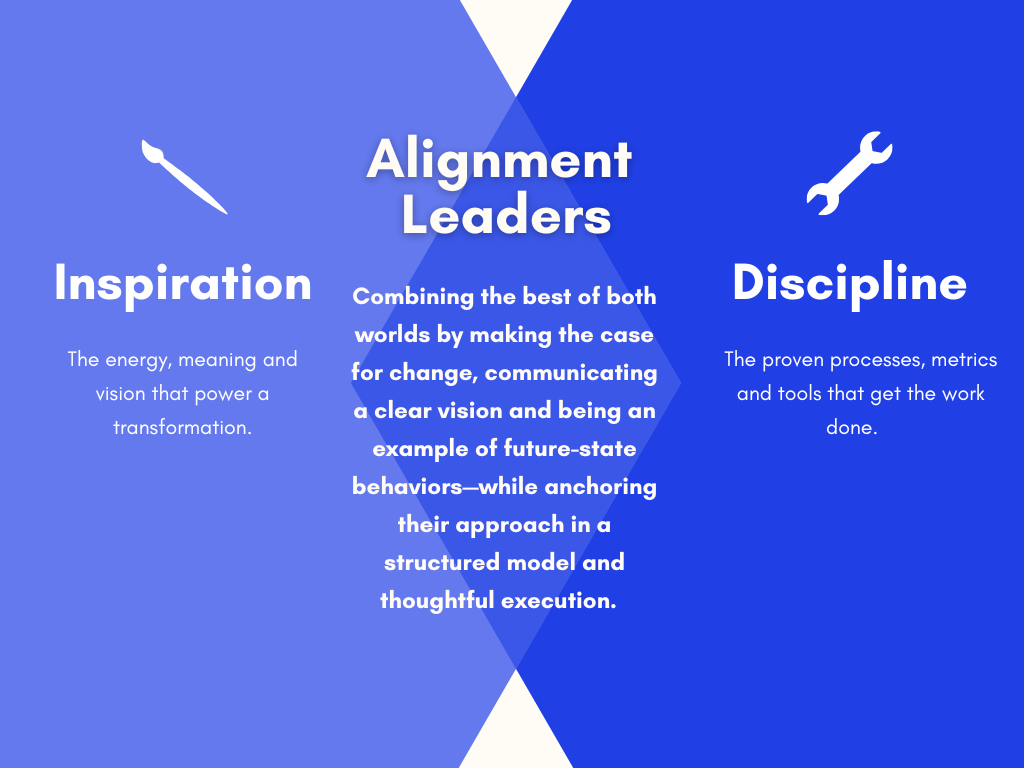
Ultimately, successful transformation requires confronting the unconscious patterns that keep organizations anchored in the current state and establishing a future state that enables them to adapt quickly and confidently. When leaders intentionally connect inspiration with disciplined execution—the poetry and the plumbing—and anchor their approach in a structured model, organizations can overcome their natural resistance to change and accelerate toward their desired outcomes.
Transformation is never easy, but with aligned leadership, clear purpose, thoughtful change management and the right balance of vision and execution, it becomes not only possible, but powerful.