In nearly every organization design engagement we take on, one of the first conversations with executive leadership is about boundaries. What’s in play. What isn’t. What the design has permission to do and where it has to hold the line.
One of the guardrails that comes up most often:
“The future org design must be headcount neutral.”
Every executive we work with understands this intuitively. They’re thinking about growth, profitability and efficiency all at once. They want to fuel growth and maximize profitability, and they know that freeing up capacity is often how you get there. There’s waste in most organizations: redundancy, misallocated effort, work that made sense in a previous model but doesn’t serve the future one. The goal is to find it, eliminate it and redeploy those resources toward what drives the business forward. Build strategic capability. Tighten the ship. Both at once, without simply adding headcount.
This is the world our clients are operating in when they bring us in, and the environment our methodology was built for: deep expertise in organization design, grounded in real practitioner experience, in service of an executive agenda we understand from the inside out.
Building a future-ready organization without adding headcount is genuinely hard work. It requires a rigorous, honest conversation about where the work is going, what it will take to do it well, and where resources need to move. That conversation is called rightsizing, and in our experience, it’s one of the most underestimated steps in the design process.
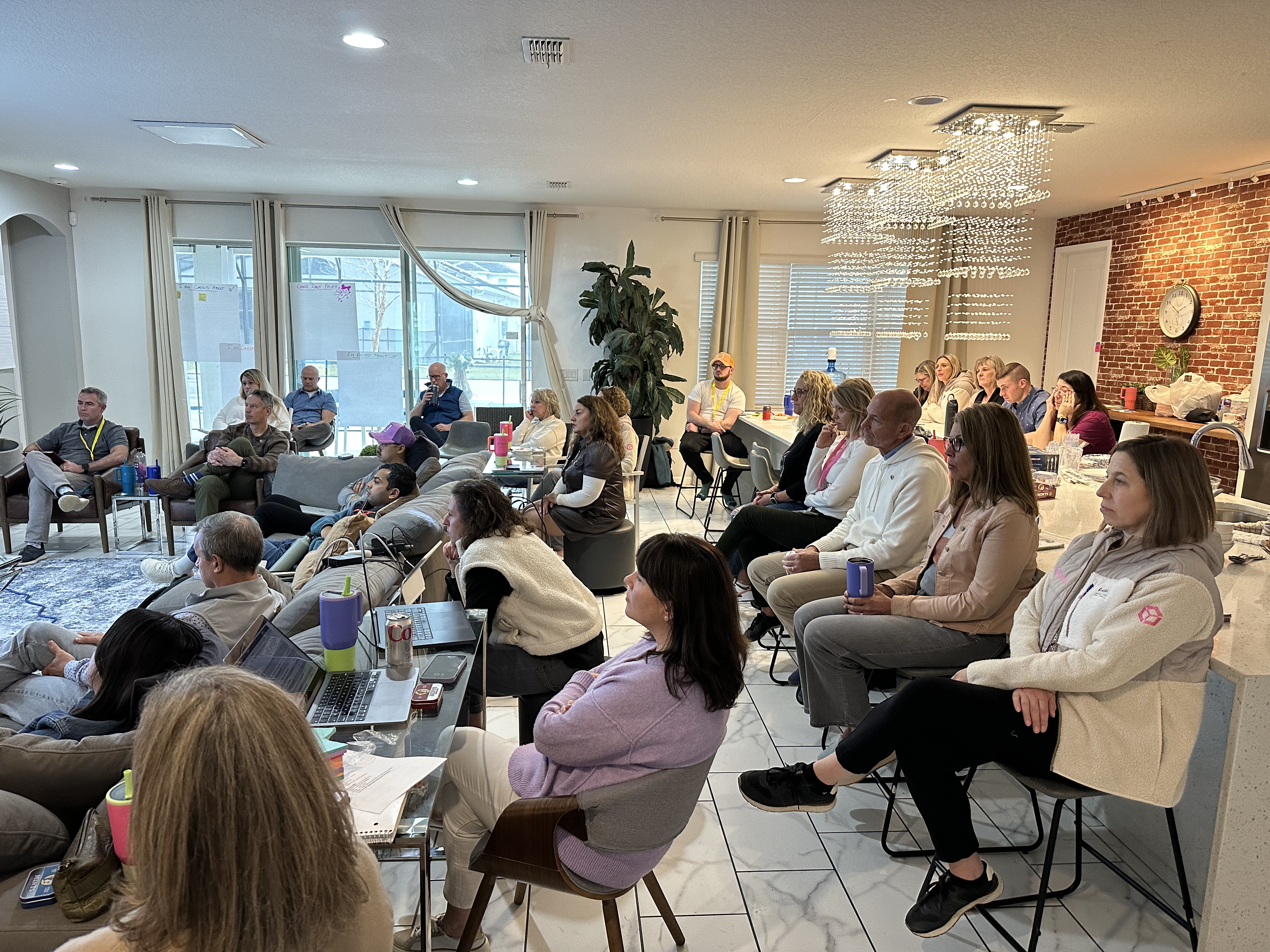
Not long ago, my team was deep in exactly this situation with a client: a large financial services organization working through a significant shift in their go-to-market model. We’d completed macro design, worked through the bulk of micro detailed design, and arrived at one of the final steps: getting the staffing right.
What Rightsizing Actually Is
Rupert Morrison draws this distinction clearly in Data Driven Organization Design. Rightsizing is not downsizing, a reactive response to financial pressure. It’s a deliberate process for determining how many people are needed to do the right work and deliver defined outcomes, positioned at the tail end of micro design: a bridge between design decisions and the activation work ahead.
His FIDRAM model gives practitioners six methods: Fixed roles, Incremental percent, Driver analysis, Ratio analysis, Activity analysis and Mathematical modelling. In our work, Driver and Ratio analysis do most of the heavy lifting. They’re the most commonly applied, and our experience confirms why.
But here’s where a deeper question enters.
One Approach Doesn’t Fit Every Situation
Dave Snowden’s Cynefin framework maps the situations organizations find themselves in into what he calls domains, each calling for different practices. In ordered, “complicated” domains, the fitting practice is Sense, Analyze, Respond. Morrison’s FIDRAM methodology is a disciplined expression of exactly that: gather the data, apply the right methods, arrive at a defensible number.
But organizations move in and out of domains, and different parts of the same organization can be in different domains at the same time. In our experience, clients working through active transformation are often in what Snowden would call a “complex” domain. Cause and effect aren’t fully clear. Strategic bets are being made about a future that isn’t fully knowable. In that context, a different practice fits: not Sense-Analyze-Respond, but Probe-Sense-Respond.
Over-indexing on analysis in a complex situation can produce false confidence in numbers the system isn’t ready to support, fuel analysis paralysis and generate precision that the organization’s still-emerging reality will quickly call into question.
At AlignOrg, our approach is to bring enough rigor to drive a productive conversation. We don’t push for completeness the system isn’t ready for.
The People Closest to the Work
In these workshops, we often bring in people who haven’t been part of earlier design sessions: managers and supervisors who live closest to day-to-day execution. They’re in the room because they should be. Their knowledge of how work functions, where friction lives and what the real constraints are is irreplaceable.
And that knowledge is also the source of the hardest tension in the room.
Because what we’re asking them to do is size new roles, or significantly changed roles, they haven’t experienced. For ways of working that simply don’t exist yet.
The debates that surface are rarely about data. They’re about trust. Will decision rights flow differently? Will the new model really change how this work gets done? Or will we end up with less capacity and the same volume of work?
But it runs deeper than trust in the design. The managers and supervisors in that room carry years of behavioral patterns with them. How decisions actually get made. What gets rewarded. How authority flows in practice, not just on paper. These patterns don’t change because the org chart changes.
This is why our methodology takes a whole-system view. The cube model we work from recognizes that structure and roles are only part of the picture. Metrics and information, rewards and incentives, leadership behavior and culture: these have to move together, coherently, or the design doesn’t take hold.
The rightsizing conversation is often where this surfaces. Not in theory. In the room.
“For me to get on board with these staffing decisions, I need to know that how we make decisions is actually going to change.”
That’s not resistance. That’s the most important thing anyone can say.
That fear is understandable. Completely human. And it’s sharpened when headcount neutrality is already in place as a guardrail. People aren’t just asking whether the design is right. They’re asking whether they can afford it and whether they’ll be left holding the bag if the cultural and behavioral shifts don’t follow.
The Science and the Art
We don’t walk into the room to deliver a report and leave. We come in as experienced practitioners with deep expertise in organization design, clear that our job is not to give the answers.
Our job is to facilitate the process that allows the answers to emerge.
We quickly read where the organization is in its transformation. We adapt our methodology and facilitation to what the moment requires. And we guide a structured dialogue that draws out the wisdom of the leaders and influencers who know this business in ways we never will.
There’s a science and an art to that. The science is the methodology: the frameworks, the data, the analytical discipline we bring into every session. The art is knowing when enough analysis is enough. Knowing when to move the conversation forward. Knowing how to help a room full of experienced people translate their deep knowledge of current state into wise, deliberate decisions about a future they’re still working to trust.
We’re not here to give you certainty, because certainty isn’t available. Organizations are complex adaptive systems. There is no perfect design. But there are exceptional designs given a particular strategy, and our expertise is in helping you make the choices that get you there. Deliberately. At a pace the system can absorb.
A Word on AI
AI is now part of this conversation in a real way. When we project that automation will absorb a meaningful share of current human work and free up capacity, the conclusion is that headcount can shift: some roles reduce, others grow, resources move to where they’re most needed.
Leaders can follow that logic. But logic and trust are different things. What they’re hearing is: you’re going to have less human capacity in a model that doesn’t fully exist yet.
This is where staging and sequencing matter. The rightsizing decisions made today are directional, not final. What we call journey management at AlignOrg addresses this directly: an activation planning approach that begins during design, not after. When people can see a deliberate, phased plan for how the transition will unfold at a pace the organization can absorb, they’re more able to reason forward rather than defend against it.
Outcome or Guardrail?
There’s a distinction worth naming clearly.
Headcount neutrality as a genuine outcome of good design is completely legitimate. The work was examined honestly, resources were reallocated thoughtfully and the design landed at neutral. That’s a real result and a good one.
Headcount neutrality established before the work is examined is something different. It shapes what’s possible before the conversation has had a chance to surface what’s actually needed. Sometimes the work confirms neutrality is achievable. Sometimes it makes a targeted case for an addition the business justifies. What matters is that the honest conversation gets to happen before the answer is assumed.
The goal isn’t to challenge the guardrail. It’s to make sure the design, and the decisions behind it, are driving the outcome rather than the other way around.
Where Are You In This?
If your organization is working through a design or transformation right now, I’d genuinely like to hear how this is showing up. Is headcount neutrality something you’re working toward as an outcome? Or has it already shaped the conversation before the real work began?
For a practical framework for navigating the activation journey that follows, see our new Executive Guide: Activating Transformation: The Leader’s Roadmap to Turning Strategy into Results.