Have you ever tried to find your way through a maze? What starts as fun can quickly turn to frustration once you realize that in the thick of things, it’s nearly impossible to find your bearings.
Leaders often feel a similar sense of bewilderment when trying to redesign an organization from the inside out. After all, when in the “maze” of everyday work, every process often seems critical and every reporting line feels set in stone. To make smart organizational design decisions, leaders must step out of the day-to-day and view the enterprise as a whole—not just the part of the business they run.
Benefits of a Strategic Balcony
When we work with leadership teams on org design, we often encourage the design team to “get on the strategic balcony.” In practical terms, it’s a discipline of elevating your perspective—getting a bird’s eye view of the maze, so to speak—so you can make design choices based on outcomes, trade-offs and enterprise impact.
- Creating deliberate distance from daily execution to focus on direction, not activity
- Looking through the CEO/enterprise lens to understand cross-business implications
- Stepping back to see patterns, dependencies and second-order effects
This shift in altitude is easier said than done. For many leaders, organizational redesign feels personal because it affects teams, roles and careers. But the leader’s job in design is to separate individuals from decision criteria—so choices are anchored in what the business must deliver, not in what is most familiar or comfortable.
The strategic balcony helps leaders enter design conversations with clarity on results, context and trade-offs. It makes it easier to see the broader system—customers, markets, capabilities and handoffs—and to make choices that optimize for the enterprise, even when they create local disruption.
Five Ways to Adopt a Strategic POV During an Org Design
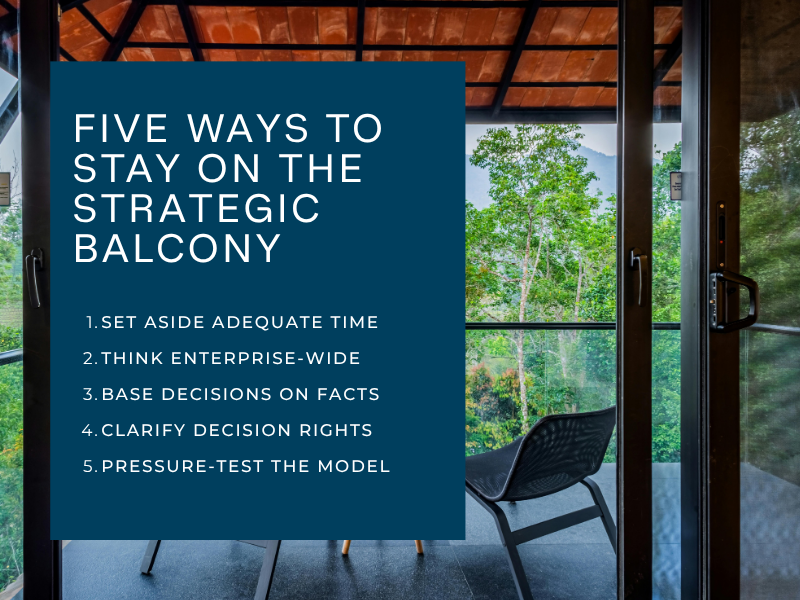
To get on, and stay on the strategic balcony during an organizational design, leaders can:
- Protect time away from operations to focus on assumptions, options and trade-offs, not just status updates.
- Apply an enterprise lens: assess impacts across customers, functions, geographies and adjacent business units.
- Ground decisions in facts and patterns (strategy, demand, capacity, cost, performance) and make constraints and “won’t do” choices explicit.
- Clarify decision rights and escalation paths so design choices don’t get pulled back into the weeds.
- Pressure-test the model with peers and key stakeholders to surface risks, dependencies and what might break before you commit.
Taken together, these practices help leaders hold a higher-altitude, enterprise-first viewpoint as they make organizational design choices. A simple next step: before your next design discussion, write down the outcomes the org must deliver and the two or three trade-offs you expect to face, then use that as your agenda.
Case Study: Realigning for Enterprise Growth
To understand the power of the strategic balcony, let’s look apply it to a hypothetical case study of a manufacturer we’ll call Apex Consumer Products.
Apex had grown rapidly through acquisitions, resulting in four distinct regional divisions. Each region operated with its own marketing, supply chain and product development teams. While this structure worked initially, growth eventually stalled. Costs ran high and the company struggled to launch new products on a national scale.
The CEO initiated an organizational redesign to shift the company from a regional structure to a global product-line structure.
Initially, the regional leaders struggled to leave the daily operations behind. During planning sessions, they fought to keep their dedicated marketing teams. They argued that centralizing supply chain operations would hurt their local vendor relationships. They evaluated the new design based on how much control they would lose, rather than what the enterprise would gain.
The breakthrough happened when the CEO asked the leadership team to step onto the strategic balcony. They spent a full day away from the office, looking strictly at enterprise-wide data. They examined customer feedback, which showed massive frustration with inconsistent product availability across regions. They reviewed financial models that revealed millions of dollars wasted on duplicate marketing campaigns.
By focusing on facts and enterprise outcomes, the regional leaders shifted their mindset. They realized that optimizing their individual regions was actively harming the broader company.
Once they elevated their perspective, the leadership team successfully designed a centralized supply chain and unified marketing department. They clearly defined handoffs between the new global product teams and the local sales forces. Because they made choices based on enterprise needs rather than personal comfort, Apex launched three new national product lines within a year and reduced operating costs by 15 percent.
Growth Requires a Strategic Perspective
Adopting a holistic view of your organization helps you navigate trade-offs and build a structure that serves the entire business. As you prepare for your next organizational design initiative, commit to stepping back and seeing the bigger picture. Embracing this mindset will drive better results for your team and your enterprise.