
Crystal clear accountability and sustained functional excellence. Both are required.
That was the mandate an aerospace and defense CEO gave his senior leadership team at the outset of a major transformation. And he meant it…literally.
He required all site leaders to be fully empowered with everything they needed to deliver—no finger pointing or excuses for missed numbers. At the same time, he expected the new design to protect and sustain the technical depth and expertise the business had taken decades to build, and it needed to grow and evolve. Nothing in a single quarter’s results was worth eroding it.
Most executives I work with want both accountability and functional excellence, and yet they often find themselves feeling forced to pick one over the other. I don’t think it has to be this way, but getting both takes more than choosing a better assortment of “boxes and wires” on an org chart.
The Three Usual Answers
You know the standoff. You ask a business unit head to give up direct authority over the engineers and other experts who create the value that makes their numbers possible. So, they resist and push back. If I don’t own them, I can’t hold anyone accountable for hitting the number. Across the table sits the opposite worry. Break up that specialist group and the standards start to drift, and the craft and technical expertise gets diluted. Often this is where the “secret sauce” of the business exists—the unique capabilities that provide the competitive edge.
So, leaders usually reach for one of three answers.
- Keep them in the function. Protect the depth.
- Embed them in the business. Protect accountability.
- Split the difference. Solid line one-way, dotted line the other.
The debate cycles for weeks, sometimes months. It rarely lands anywhere, because each option gets judged on which value it protects rather than on what the work truly requires.
What, specifically, are we protecting?
Ask the functional leader what they’re afraid of losing, and the answers are scattered:
- Consistent technical standards
- Bench strength and talent pipeline
- Depth that stays deep because experts sharpen each other
- The ability to move scarce specialists to wherever the hardest problems exist.
Numerous organizational challenges all grouped under one name—functional excellence. In reality, each issue usually has a different answer. As long as the conversation stays at the level of functional excellence, leaders are weighing a bundle of associated issues against clear accountability and strong execution, and that debate has no winner. Get specific about the unique challenges for which functional excellence is striving to solve, and the conversation shifts. The question changes from which value wins to what will protect/strengthen this particular thing.
The Reporting Line is Not Always the Answer
Underneath all of this sits an assumption that functional excellence comes from the direct reporting line. Executives believe this for good reason. Often, this is true in practice, even if it is never true in principle.
When a function lives under one leader, the structure groups together a variety of work processes and activities that together create excellence—i.e., common standards, shared coaching, technical reviews, and clear career paths from junior to senior. All of this lives “inside the box,” so it’s easy to credit the box. In reality, the reporting line wasn’t the reason functional excellence was achieved; rather, it served as the container for the required work activities for excellence to flourish.
Reporting relationships do one job well: they establish accountability. They tell you who owns a decision and who answers for a result. Standards, technical depth, career paths, the muscle memory of a craft, those are sustained by the linkages you build around the structure.
Structure determines who decides. Linkages determine how the organization works together. Redraw the chart and the linkages rarely grow back on their own. Most organizations assume they will, then blame the new structure for a problem the missing linkages caused.
The Dotted Line Isn’t a Rescue
Which brings us to the third solution. Dual reporting gives the specialists a business boss and a functional boss, and it looks like a way to have both benefits with no downsides. Drawing that second line on the chart is easy. Announcing that this is how we will operate is easy. Making it work is far from easy. People in this dynamic consistently report less clarity about what’s expected of them (which turns out to be one of the better predictors of how an organization performs).
I want to be careful here, because we deliberately design matrix structures that are successful. A matrix is a legitimate structural choice, but it should not be chosen to avoid making difficult tradeoff decisions.
The design work is often the easy part. Interlock the targets so both leaders are working one plan. Put a shared result in both sets of numbers. Name who holds the tie-break on the decisions everyone knows will be contested. You can finish all of that in a workshop.
The test comes when the new design must survive a hard quarter. A matrix requires leaders to behave, consistently and under real pressure, in ways the previous structure never rewarded. Give up a scarce specialist when your own timeline is slipping. Accept being measured on a result you don’t fully control. Settle a disagreement with a peer instead of escalating it. Collaborate without turning every decision into a committee.
It’s easy to agree on playing nicely together during a design session. It’s much harder to repeat on Day 200 when incentives still reward the old behavior. Protecting your own people is the rational choice, not a lapse in character. Leaders often agree to collaborate “in the matrix” without understanding what it will cost them. The tendency is to comply on the surface, protect their own underneath and point at the structure when the results disappoint.
Matrix readiness is a selection and development question long before it is a design question. In my experience matrices rarely fail as a structural design choice. They fail in practical execution.
Diagnose Before You Design
Name what’s genuinely at risk, then choose the linkage that addresses it.
- Inconsistent standards point to governance and standards ownership.
- Losing the next generation of critical SMEs points to talent mobility and a real community of practice.
- Deep expertise spread too thin points to rotation programs and deliberate cross-business staffing.
Get it wrong and it can cost you either way, but the two failures look different.
- Keep the work in the function when it belonged with the business, and the disruption shows up fast. Key priorities are set and governed in ways the business leader can’t control. Specialists produce excellent answers to questions the market stopped asking two quarters ago.
- Pull it into the business, when it needed to stay centralized, and the damage is slower and harder to see. Nothing immediately breaks. Each unit gets its own small team, and the tyranny of the urgent supersedes the need to share best practices across and within the specialist teams. Then the day comes when you need to fill a senior role requiring deep, cross-business technical competence, and you have no one internally capable of stepping up.
One failure is abruptly felt. The other compounds in silence, and leaders overcorrect against the first because it’s glaringly apparent.
Diagnosis Tip: It’s also important to look for shadow work while you diagnose. It is not uncommon to find that business leaders have quietly built their own versions of what central functions were supposed to provide. Shadow work tells you a real need is going unmet, and it should be assigned an intentional home in the new design.
What the Aerospace & Defense Team Found
Thinking back to the aerospace and defense team, their design engineering was strong and nobody proposed touching it. However, manufacturing engineering was a weak point that was thin across all three sites, and the instinct was obvious—pull it under engineering to be developed and shared across the enterprise. Weak functional capability, so make the choice to protect and grow it.
One site leader pushed back hard. He recalled how they had tried this before and it had failed miserably. His argument wasn’t that centralizing was bad. It was that for their business, manufacturing engineering was not a highly transferable capability. Design engineering principles and competence traveled well between sites. But how you build this product, on this line, against these constraints, did not.
Additionally, he argued that to move manufacturing engineering (who were critical players in delivery) into someone else’s direct control would run against the mandate to fully empower site leadership…which would perpetuate the culture of excuse-making and finger-pointing they were trying to eliminate.
They decided to pull it back under the site leaders. The original instinct wasn’t wrong. Manufacturing engineering really was weak. But weakness in a functional capability can often be a linkage problem, and relying on structure to solve a problem better addressed by a linkage can leave you further behind than you started.
Six Questions Before You Move the Boxes
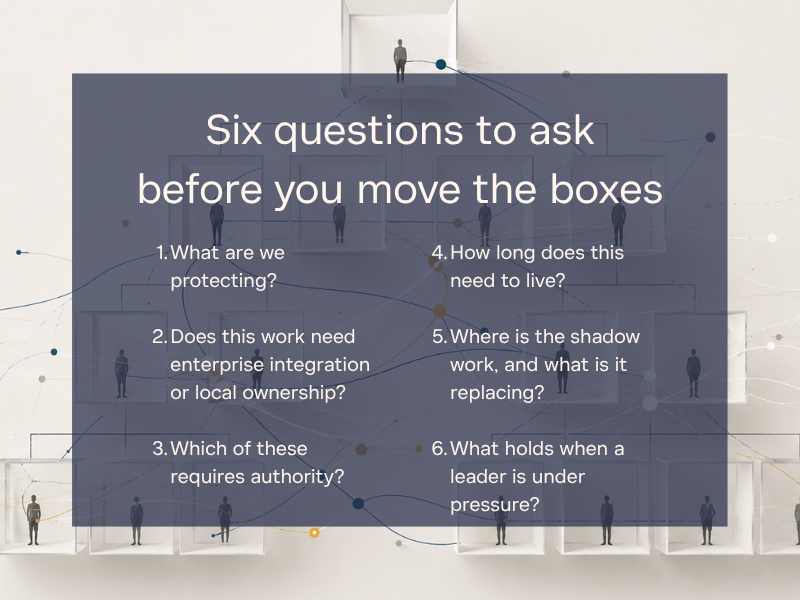
The following set of questions won’t tell you which design option to choose, but they can serve as a helpful guide to make more informed decisions related to functional excellence.
- What exactly are we protecting? Not the idea or value. The specific work. If the answer is still “functional excellence,” better diagnosis is required.
- Does this work need enterprise integration, or local ownership? Some work creates value by being consistent everywhere. Some creates value by staying close to a market/location and moving fast. Most functions hold both kinds to some degree, and it’s important to determine which is the priority.
- Where is authority required, and over which decisions? Authority doesn’t need to be all-or-nothing. It can show up as hiring and firing, as work direction and prioritization, or as performance management, all of which can sit in different places. Name the specific decisions before you name the boss.
- Is this permanent or temporary? Stewardship of a standard usually needs to last over time. Transferring a skill to a team that lacks it does not. Give temporary work an end date to avoid the tendency to quietly become permanent.
- Where is the shadow work, and what is it replacing? Find the work that is being performed out of necessity, then ask what it’s compensating for before you decide whether to absorb it, legitimize it, move it or leave it alone.
- What holds under real pressure? When deadlines and KPIs are in jeopardy and leadership owning execution wants to override the standard, who can stop them and on what authority? If the answer is that everyone will sit down and work it out, you don’t have a linkage—you have wishful thinking.
Organizations don’t lose functional excellence because they decentralize. They lose it because they decentralize without designing the linkages that create and reinforce expertise. The CEO was right to demand both. He needed a team willing to lean into the challenge of sorting out what work needed to be resolved by structure versus that which was better resolved by linkages.
How do you understand and design for functional excellence? Have you seen an organization actually achieve and maintain it? If so, how did they do it?