
Many organizations today are pursuing bold strategies—growth into new markets, digital transformation, customer-centric operating models and innovation-driven business models. Yet even with clear strategic direction, execution often lags. One of the most common reasons is that the organization is structured around legacy processes, historical functions or inherited workstreams, rather than around the capabilities required to deliver the strategy.
“The Way We’ve Always Done It”
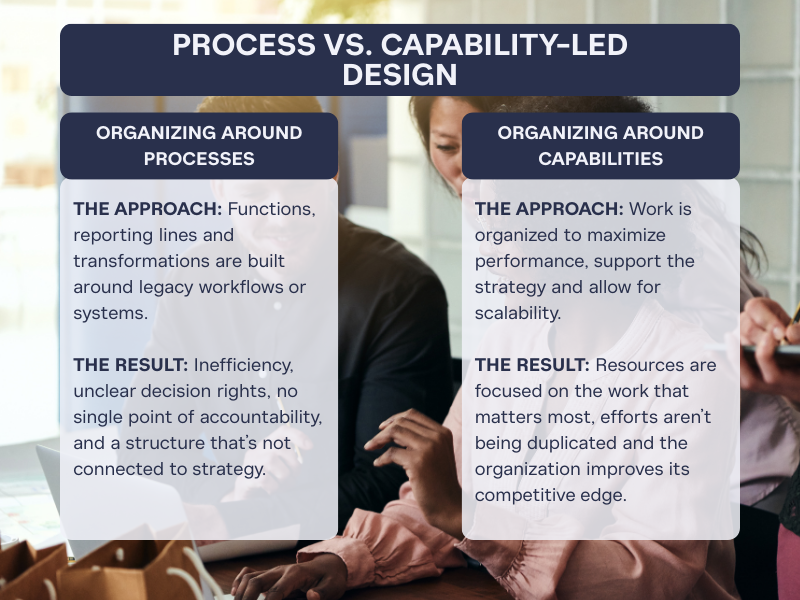
At AlignOrg, we frequently observe that work is often organized based on “how things have always been done.” This mindset then guides the creation of functions, reporting lines and transformation workstreams. Over time, this creates fragmentation: capabilities that should operate seamlessly across the enterprise are split across multiple teams, decision rights are unclear and accountability becomes diluted. The result is not a lack of effort, but a lack of organizational alignment to strategy.
A Capability-Led Approach
Strategy defines what the organization must be able to do well—its differentiating and enabling capabilities. Organizational design must then answer a different but equally important question: What is the best way to organize the work so those capabilities can be built, strengthened and sustained? This shift—from organizing around processes to organizing around capabilities—represents one of the most important evolutions in modern organizational design.
When capabilities aren’t linked to structure and ownership, organizations often create workstreams that optimize individual functions but fail to deliver enterprise outcomes. For example, customer experience, data analytics or product innovation capabilities may be scattered across marketing, operations, IT and finance. Each has partial ownership, but there is no single point of accountability. Even well-funded transformation programs may struggle under these conditions if the organization is not structurally aligned to deliver the capabilities required for success.
A capability-led design approach begins by:
- Identifying the critical enterprise capabilities required to deliver the strategy.
- Distinguishing capabilities that differentiate the organization from those that enable it to operate effectively.
- Evaluating organizing rationales based on how work should be grouped to maximize performance, clarity and scalability.
In some cases, this may mean consolidating capability ownership under a single leader. In others, it may involve creating cross-functional operating models, shared services or integrated workstreams designed to strengthen capability delivery. The goal is not to force a single structural model, but to determine how best to organize the work that supports each capability.
The Benefits of Capability-Led Design
This perspective also reframes transformation efforts. Rather than structuring initiatives around functional boundaries or project categories, transformation workstreams can be aligned directly to capability development. This ensures that resources, governance and accountability remain focused on the outcomes that matter most.
When workstreams are anchored to capabilities instead of processes:
- The organization gains greater clarity around priorities.
- The team is no longer duplicating efforts.
- The connection between transformation investments and strategic results is strengthened.
Importantly, capability-based design does not eliminate functions. It ensures that functions operate as platforms that enable capabilities, rather than as silos that unintentionally constrain them. Functions remain essential for building expertise, developing talent and delivering operational excellence, but the organizing logic for enterprise execution shifts toward capabilities and outcomes. This approach helps organizations maintain functional strength while improving cross-enterprise coordination and accountability.
Designing for the Future
In an increasingly competitive and fast-changing environment, the organizations that succeed will be those that move beyond legacy organizing logic and intentionally design around the capabilities that drive enterprise value. By linking capabilities directly to strategy and organizing work in ways that best enable those capabilities to thrive, leaders can ensure their organizations are not only well-structured for today’s operations, but built to deliver the outcomes required for tomorrow’s growth.