
In many organizations, content marketing can feel like an afterthought—something everyone agrees is valuable, but no one truly owns. At AlignOrg, we found ourselves in that exact position. We had brilliant practitioners, rich insights and no shortage of perspectives worth sharing. Yet our internal blog struggled to maintain consistency and momentum.
It wasn’t a lack of commitment. It was a lack of design.
When Good Intentions Aren’t Enough
Over time, very specific friction points emerged that showed us our approach needed to change:
- Someone would volunteer to write, but client delivery would escalate and the deadline would slip. This left us scrambling to curate something quickly—or not post anything at all.
- The writing burden fell on the same few authors. They became overwhelmed, burned out, or simply ran out of ideas.
- We tried planning quarterly themes and prescribed content topics, only to find that many authors didn’t have personal experience or context to write authentically. Posts stalled before they were ever drafted.
These challenges weren’t signs of poor performance—they were symptoms of an underdesigned process.
The Questions We Had to Ask Ourselves
As these friction points came into view, we stepped back and asked deeper questions that ultimately reshaped our entire approach:
- What expectations are realistic for consultants whose primary responsibility is client delivery?
- How do we make writing feel supported rather than stressful or last-minute?
- Who should own each part of the workflow so that accountability is shared—not concentrated?
- How do we ensure content is high-quality and authentic when not every author can write on every topic?
- What tools or structures (templates, deadlines, review steps) do we need to make the process predictable?
- How do we balance strategic content goals with the reality that the most resonant posts emerge from lived experience?
These questions became the catalyst for applying the same organization design principles we use with clients—this time, to our own internal content engine.
Designing the Blog Process Like an Operating Model
Once we framed the problem through an org design lens, the path became clear. We needed role clarity, governance, workflow and capability support—the same essential components of any operating model.
Here’s what changed:
Clear role definition
We assigned ownership for idea submission, drafting, editing, review, scheduling and publishing. No more ambiguity or shifting responsibility.
A flexible content calendar
Instead of rigidly prescribing topics, we shifted to a calendar that identifies the slot and owner, while giving authors freedom to write from their own experience. The result: more authentic content, less pressure.
A documented workflow
We created a repeatable process—from idea → draft → review →edits → approval →publish—so no post stalled halfway without visibility.
Reasonable expectations
We acknowledged that delivery takes priority and built a system that doesn’t break when someone gets busy. Backup authors, rescheduling protocols and content buffers now support continuity.
Review and governance
Roles were clarified around who edits, who approves and who ensures brand consistency.
Creative and emotional support
We added templates, guidance, examples and optional brainstorming sessions so writing doesn’t feel intimidating or burdensome.
Together, these changes transformed our blog from an ad hoc effort into a sustainable, reliable process.
What Happened After We Rebuilt the Process
The transformation wasn’t just operational—it was cultural.
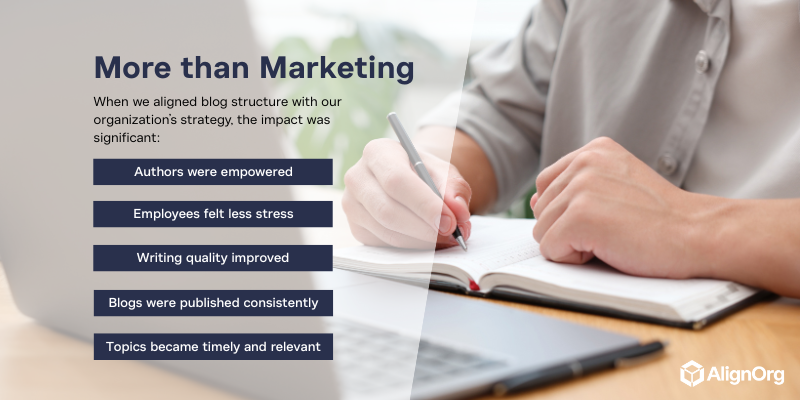
- Authors felt more empowered because they could write on topics grounded in their own work and experience.
- We developed a healthier cadence, publishing more consistently with significantly less stress.
- The workload became more distributed, avoiding burnout among frequent contributors.
- We saw higher quality and clearer thought leadership, because posts came from authentic practitioner insights rather than assignments.
Most importantly, we aligned our behavior with our beliefs: that structure enables strategy, even in something as deceptively simple as a blog.
Why This Matters Beyond Marketing
This experience reinforced something we often teach but rarely get to observe in such a controlled environment: micro‑processes reveal macro‑truths.
- Small friction creates big drag.
- Clarity improves confidence.
- Governance sustains momentum.
- Authenticity outperforms prescription.
- And well‑designed workflows free people to operate at their best.
The internal blog became a microcosm of organizational health. When we designed it well, everything improved—not just output, but morale, collaboration and contribution.
A Final Reflection
It’s easy to dismiss something like a blog as “just a marketing function.” But when you look closely, it touches strategy, culture, roles, governance and capability building.
For us, redesigning our blog process became a living demonstration of the power of organization design. It showed that clarity, structure and thoughtful workflow aren’t restrictive—they’re what enable creativity, consistency and meaningful impact.
If we can apply org design principles to something as small as an internal blog and see results, imagine what’s possible when we bring the same rigor to the larger, more complex systems inside an organization.