
Predictions about artificial intelligence (AI) seem to be everywhere these days, with most declaring that AI will revolutionize the economy.
It might not be that simple. The Brookings Institute noted recently, “AI’s diffusion into the economy may not prove as wide-ranging as imagined. For one, the technology’s impact depends on what tech expert Nicolas Colin says is the effectiveness with which different industry sectors turn AI efficiency into ‘lasting productivity and economic growth.’ Some firms and industries will do this well, and others won’t.”
How can enterprises ensure they apply AI successfully? As AI moves from emerging technology to a general-purpose business tool, leaders should realize that simply deploying AI across their organization won’t necessarily guarantee results. The real differentiator for executive leaders is strategic clarity and deliberate design—not just more AI.
AI Doesn’t Automatically Create Value
The recent spotlight on AI has fueled a common misconception: the mere act of introducing it to an organization automatically creates value. “Tech vendors are driving and financing much of the current hype over AI as they relentlessly innovate and flood the market with AI-embedded technologies.” Gartner reported, reminding tech leaders: “As a CIO, you’re not in that race; you are in a race to deliver AI outcomes safely and at scale.”
In reality, it takes a combination of factors, including:
- specific AI goals
- an intentional strategy
- human oversight
- solid data careful
- workflow integration
AI doesn’t create value on its own: it amplifies the strategic organization design choices that leaders make. And unless AI is implemented with strategic intent, it can introduce its own set of problems. The speed and power of AI holds both promise and peril. Automation can introduce new misalignments and amplify old ones—particularly ones that were previously undetected. New tools can alter roles and responsibilities, blur decision rights, disrupt metrics and fragment accountability.
How AI Ripples Across the Organization
An example from our recent executive guide, Designing AI Into Your Operating Model, illustrates how one company’s treatment of AI as a simple technology upgrade brought missed opportunities and new inefficiencies:
- The firm introduced an AI-powered document review system to streamline compliance reviews, replacing processing that had evolved independently across multiple regional offices.
- When the firm attempted to implement one system for all offices, it found the need for multiple local customizations undermined the project’s projected ROI.
- The lack of clear governance and decision-making authority for AI training also brought conflicted guidance, eroded trust and prevented the firm from reaching its goals for AI.
As the case study illustrates, AI doesn’t stay in its lane: its effects can be felt far beyond the scope and intent of the original plans. Regardless of whether our clients start with a small chatbots pilot or a broader rewiring of the entire enterprise, AI rarely stays contained to the initial area of focus.
AI also affects culture as the human workforce interfaces with the technology. For example, chatbots change not just workflows but roles and work within customer service. Relying on AI forecasting models changes how departments create financial plans and how much decision-making power they concede to the AI tool. The skills that talent needed in prior years may change or become outdated as AI takes on a larger role.
Integrating AI with Strategic Design
Ultimately, leaders must understand and communicate the importance of integrating AI into the operating model by design—not just deployment. You shouldn’t implement AI just because it’s the tech “flavor of the month” and everyone else is doing it. AI works best when deployed with a clear strategic purpose that aligns with your organization’s value proposition.
Begin by focusing on where you want AI to make an impact. Classify those goals by:
- Differentiating capabilities: These reinforce customer perceptions, market position and your overall strategic identity.
- Foundational capabilities: Necessary but non-strategic activities (such as compliance) where you could cut costs and free up resources to address differentiating capabilities.
Once you group your capabilities, focus on how AI can support those capabilities. Can you use AI to make processes more efficient? To restructure roles and improve workflows? Or can it help you pursue new market opportunities?
After you decide how to use AI, you must also determine how to redesign your organization to handle the inevitable ripples it will cause across the enterprise. AlignOrg’s Cube Model offers a guide for identifying how AI will affect your company and modifying your organization design to accommodate those changes. Like a Rubik’s cube, the Cube Model has six sides representing different aspects of an organization. Start by considering how AI will change work and then move outwards to determine the impacts on such aspects as people, culture and metrics. Following this process allows you to ensure AI fulfills its potential in your organization.
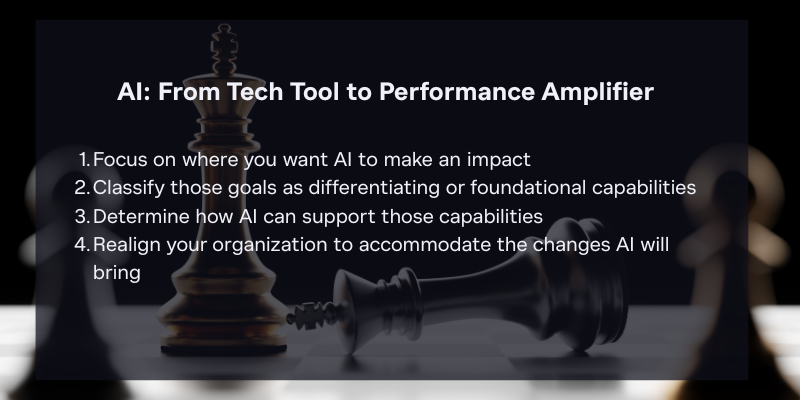
To succeed with AI, leaders must move beyond technology adoption. They must focus on aligning AI with their organization’s unique value proposition. The real challenge is not the technical introduction of AI, but rather the ability to successfully integrate it with your enterprise-wide goals and objectives. Strategic design is what turns AI from a tech tool into a true performance amplifier.