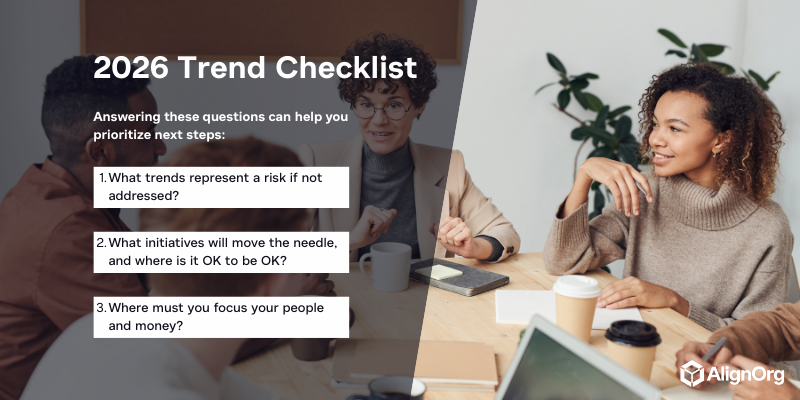
Human resources is no longer just a support function—it’s a strategic driver of growth. When thoughtfully designed, it can help your organization become more resilient, innovative and productive. In the blog, we’ll spotlight emerging HR trends, identify their challenges and explore how you can address them with clarity, alignment and intent. The goal? To enter the new year prepared and poised for success.
Here’s what you need to know:
1. AI: From Adoption to Adaptation
AI has gone from a shiny new toy to a commonplace tool, but are we using it in ways that really move the needle? According to a recent Korn Ferry report, only 5% of HR teams feel ready to effectively implement AI.
Challenges: Without oversight, AI can create “workslop”—output that looks polished but ultimately lacks substance and takes time and effort to correct. AI usage also raises ethical concerns, such as hiring tools that exhibit gender and racial biases.
Action Plan: Think of AI not as a set-it-and-forget-it function, but as something that requires human oversight. Audit your AI tools to ensure they’re increasing productivity and creating high-quality outputs and keep humans in the loop for critical functions like hiring and performance management.
2. The Shifting Leadership Landscape
The days of spending your career at one company are long gone—and changing demographics and the introduction of AI are going to shake things up even more. It’s time for HR to prepare for seismic shifts in the traditional leadership pipeline.
Challenges: The leadership landscape is changing. Americans are now reaching retirement age in record numbers. The way employees think about their careers is changing too, as the “job hopping” Millennial generation progresses into senior leadership positions. At the same time, AI is flattening structures by decreasing the need for entry level positions. The potential fallout from all these shifts? Expertise gaps, a disruption in workforce continuity and fewer mentors for early talent.
Action Plan: When it comes to transferring knowledge, the best defense is a good offense. Don’t wait until a retirement announcement to act. Start now by identifying your retirement-eligible population and mapping their critical skills. Consider implementing programs like apprenticeships and alumni networks to keep talent pipelines strong.
3. The Skills-Based Talent Strategy
Traditional role-based hiring is taking a back seat to a new model: the skills-based talent strategy. Moving to skills-based hiring provides companies with better flexibility and growth.
Challenges: Adopting a skills-based approach to hiring can help your organization stay agile and competitive, but it’s not without challenges. It requires a mindset shift from both employees and leadership, and purposeful attention to skill development. According to a recent Gartner study, more than 60 percent of employees say they aren’t getting the on-the-job coaching they need to support their core job skills.
Action Plan: Keep your employees sharp by building continuous learning opportunities into your organization. Strategies like employing internal gig work and building cross-functional teams can help you leverage hidden talent and respond with agility to market shifts. At the same time, ensure that your career progression model and compensation strategies are evolving to keep pace with new hiring and employee development models.
4. Emphasis on the Employee Experience and DEI
The “Great Resignation” is over, and employees are returning to the workplace with an eye on purpose and culture fit. At the same time, DEI initiatives must evolve from standalone programs and become integrated into core business operations.
Challenges: The days of the one-size-fits-all employee experience are in the past. Today’s new talent wants an employer that cares about their professional—and personal—well-being. The DEI initiatives that took root at the start of the decade are now 5+ years old, and it’s time to evaluate what’s working and what changes still need to be made.
Action Plan: Employee well-being is more than just a buzzword. Implementing programs that offer flexibility and support mental health can help your organization improve productivity, retention and employee engagement. AI can help you take these initiatives beyond a cut-and-paste template, providing employees with customized experiences like tailored wellness programs and specialized trainings.
For DEI, consider how you can better embed values into leadership practices. Are they reflected in decision making and team engagement efforts? Identify underrepresented talent within your organization, and shift from mentoring to sponsoring—actively advocating to ensure they have an equal opportunity to receive promotions and participate in special assignments.
The Bottom Line: Design for What Matters
The future of HR isn’t about doing more; it’s about focusing on what delivers the most value. Be clear on your HR value proposition and prioritize the work that supports it.
Every operating model has trade-offs. The goal is to make deliberate organizational choices that solve for the downsides. By aligning your structure, processes, and metrics, you can build an HR function that actively shapes the future of your organization.